
From clinical pathway to patient pathway.
Loupa starts with how care is already delivered. We map the patient journey, identify where information, preparation and communication matter most, and build the digital pathway around those moments.
A simple framework, adapted to the clinical service.
Understand the patient journey and find where uncertainty, questions or friction occur.
Bring existing information together and design the experience around the pathway.
Confirm clinical content, ownership, accessibility and operational responsibilities.
Connect the pathway to care through links, QR handouts and the service workflow.
Use patient and staff signals to identify where the pathway can be refined.
Map the pathway. Find the friction.
Before designing anything, Loupa looks at how the patient actually moves through the service. The aim is to identify where information, preparation or communication can make the pathway easier to navigate.
Start with the moments that matter.
The pathway is mapped from the patient’s perspective, including the decisions they face, the information they receive and the points where questions commonly emerge.
Referral, clinic, direct-to-test, booking or another point in the service.
Identify the moments where options, risks and patient preferences need discussion.
Find the issues patients commonly remember or worry about after the consultation.
Look for preparation, practical guidance and common explanations repeatedly given by the team.
Decide whether information belongs before, during or after a particular clinical interaction.
Identify how patients can reconnect when reflection creates further questions.
Bring what you already have.
Most services are not starting from nothing. Existing patient information can be reviewed, reorganised and incorporated into the pathway rather than replaced simply because the delivery format is changing.
You do not have to start again.
Loupa can work with the information a service already sends to patients and bring it into a structure that follows the clinical journey.
Turn separate documents into one patient journey.
In the existing gastroscopy process, some information could be sent as a separate document that the patient then had to open and read alongside the main information. Loupa can bring that content into the relevant stage of the pathway itself.
The patient has to recognise another document, open it separately and understand how it relates to the rest of their preparation.
Preparation guidance can sit inside the same patient journey and remain available when the patient returns later.
Design the experience. Connect it to care.
Once the pathway is understood, the information is structured around how patients actually use it: on a phone, over time, alongside conversations with clinicians and the people supporting them.
Make the useful things easy to find.
Clinical information, practical guidance and patient actions can sit within one clear mobile pathway.
Quick actionsHelp patients bring their thinking back into the consultation.
Questions and priorities can be collected as they arise, then reviewed when the patient returns to the clinical conversation.
Would watchful waiting be reasonable for me?
SavedWould you expect to use mesh?
SavedReflection can remain on the patient’s own device until they choose to bring it back into the clinical conversation.
Connect the pathway to the moment of care.
A physical handout can provide a simple bridge from the consultation to the digital pathway. In other pathways, the same information may be delivered electronically at the appropriate point in care.
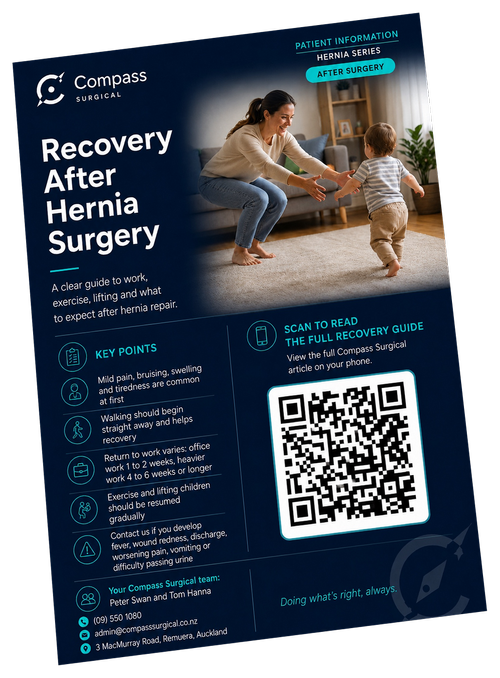
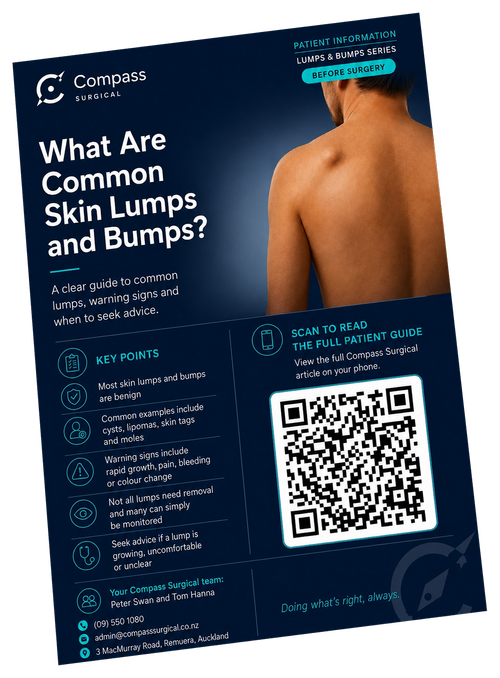
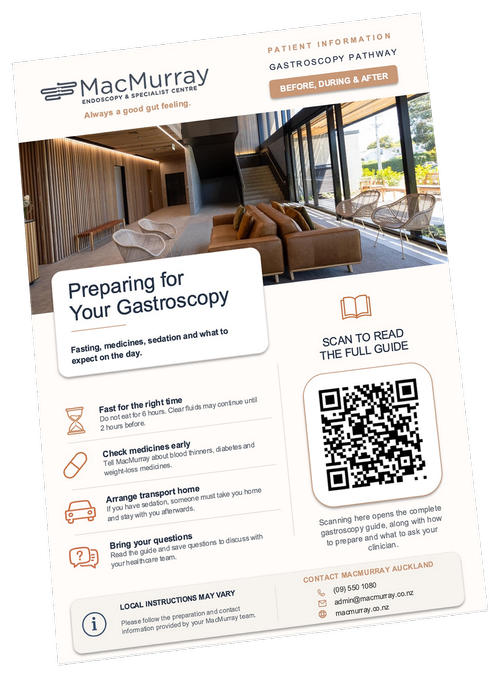
Create a concise physical bridge from the clinical interaction to the digital pathway.
Link directly to the correct pathway and maintain the destination as the service evolves.
Apply the service identity and prepare professional files ready for production.
Support production so the handout is ready for use within the clinical workflow.
Review, approve and make responsibilities clear.
Before a pathway is released, the clinical content, patient journey and practical workflow are reviewed with the service. Approval, ownership and future review requirements are then recorded clearly.
Review more than the words on the page.
A safe pathway depends on the clinical content and the surrounding service process working together.
Confirm diagnoses, options, risks, preparation, recovery advice and safety-netting.
Check that information appears at the right point in care and reflects how the service actually works.
Confirm who receives patient contact, who responds, where clinically relevant communication is documented and how changes are managed.
Record the clinical author, reviewer, approval status, version and review date before release.
The live Compass Surgical hernia guide carries its clinical governance information within the patient pathway itself.
Consultant General Surgeon, Compass Surgical
Consultant General Surgeon, Compass Surgical
Approved for Compass Surgical patient use
Next formal review August 2027, or earlier if evidence, guidance or local practice changes
The patient guide supports discussion with healthcare professionals. Recommendations still need to be applied to the individual patient, their condition, health and circumstances.
The pathway can be reviewed earlier if important evidence, safety information, clinical guidance or local care processes change.
Questions, priorities and other saved information can remain locally on the patient’s device unless they choose to bring them into the clinical conversation.
Owns clinical advice, individual care, patient communication, documentation and consent.
Provides patient pathway architecture, information design, software and the governed patient-facing platform structure.
Patient information should support the conversation.
A leaflet can provide information. Loupa is designed to help patients understand it, return to it, reflect on it and bring better questions back to their healthcare team. The consultation remains at the centre of care.
Built around conversations
Patients can save questions as they arise, reflect on what matters to them and return to those prompts when they meet their healthcare team.
Designed for the whole journey
Information remains useful before, during and after clinical conversations, so patients can revisit it when new questions arise or the next stage of care begins.
Made for your service
Real people, real facilities, local instructions and the actual pathway patients will experience. The guide should feel connected to the healthcare service providing their care.
Built to keep improving
Simple feedback, understanding checks and engagement patterns can show where information is useful and where it may need refinement, creating an ongoing patient-informed improvement cycle.
Technology prepares. Healthcare professionals provide personalised care. Loupa is designed to strengthen that relationship, not replace it.
Ready to rethink your patient information?
If you are a clinician, hospital or healthcare organisation looking to improve how patients prepare for care, understand their pathway and participate in consultations, we would like to talk.
Loupa Patient · Relationship-centred digital patient information.