Preparing for abdominal wall reconstruction
There is quite a lot to understand before a major abdominal wall reconstruction. You do not need to take it all in at once.
Use this guide in whatever way works for you. Read a little now and come back to it later. Open the extra detail when you want it, share it with your family or someone you trust, and give yourself time to think about what matters to you.
As you go, you can save your questions and the things that are important to you. Bring them back to our next conversation so we can discuss them together.
Quick actions
Contents
Select a chapter to go straight there.
Quick actions
Questions and selections are saved on this device.
What has happened to my abdominal wall?
An incisional hernia is more than just a lump. It means there is a hole or gap in the deeper supporting layers of your abdominal wall.
First, what does the abdominal wall do?
Your abdominal wall is made up of layers of muscle and supporting tissue. It protects the bowel and other organs inside your abdomen, but it also helps with everyday things such as posture, movement, getting up, passing urine and opening your bowels.
When these deeper layers stop working normally, the effects can be much more than simply changing the shape of your abdomen.
What is an incisional hernia?
An incisional hernia occurs when there is a hole or gap in the deeper layers of the abdominal wall, often through an old surgical scar.
As the muscle layers separate, bowel or fat from inside the abdomen can push through the gap. This creates the lump or bulge that you can see or feel.
What might I notice?
Hernias come in all shapes and sizes.
You may notice a lump or change in the shape of your abdomen around a previous surgical scar.
The bulge may become more obvious when you stand up.
It may become smaller or disappear when you lie down.
A large hernia can make things such as sitting up, walking and opening your bowels more difficult.
What can an incisional hernia look like?
Incisional hernias vary enormously. This real clinical photograph shows one example. Your hernia may look very different.
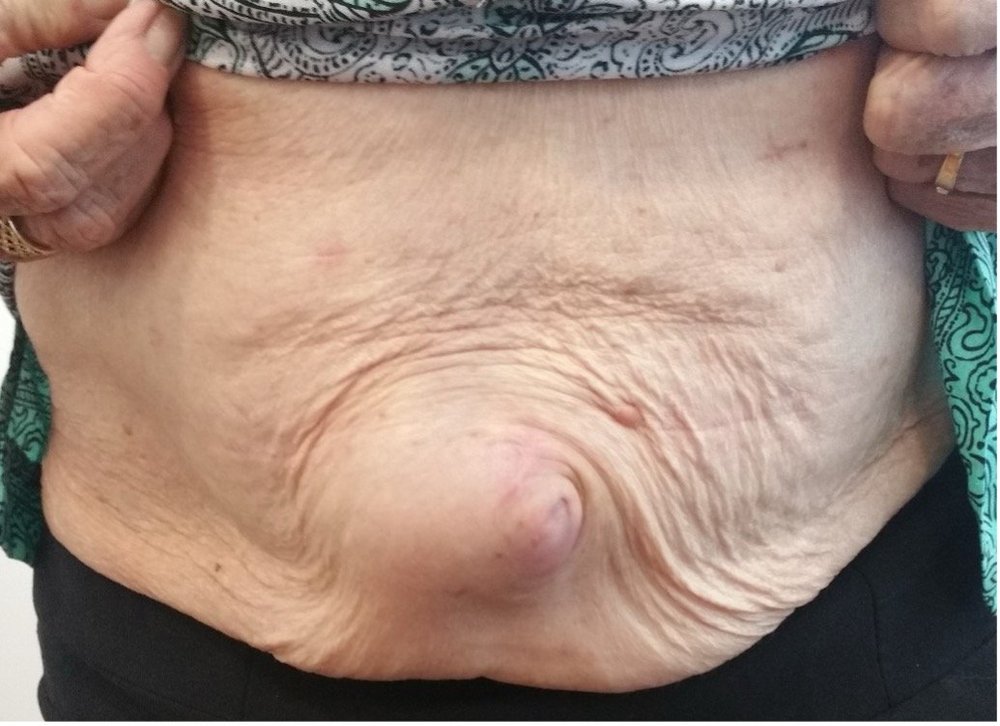
Example of an incisional hernia. Incisional hernias can look very different from one person to another.
Why can an incisional hernia become so large?
Many of the people I see with very large incisional hernias have already been through serious illness, long hospital stays, repeated operations and several complications. There may also have been previous attempts to repair the hernia.
The muscles that were originally stitched together can separate and the bowel can gradually push forward through the gap.
In a very large hernia there may eventually be a wide space between the muscles. In extreme situations, some of the bowel may sit outside its usual position inside the abdominal cavity.
This is one reason complex abdominal wall reconstruction can be very different from repairing a small, straightforward hernia.
Why does the skin over the hernia matter?
In some very large or complicated hernias, bowel may be covered by only a thin layer of skin or a previous skin graft.
That skin can be vulnerable to injury or ulceration. Occasionally a hole can develop between the bowel and the skin. This is called a fistula.
This is an especially difficult problem and is one of the reasons these operations sometimes require careful planning and several different specialists.
Why might this have happened to me?
There is rarely one simple reason. I look at a number of things that can contribute to an incisional hernia, including:
- previous operations through the same incision
- wound infection after surgery
- obesity
- diabetes
- a previous severe abdominal illness or operation
- a colostomy or other stoma
- medicines such as long-term prednisone or other immunosuppressive treatment
These factors can also be important when planning reconstruction, which we come back to later in the guide.
Is a divarication the same as a hernia?
No. A divarication, sometimes called rectus diastasis, is a widening or separation between the abdominal muscles.
It can produce a very noticeable bulge, and many people mistake it for a hernia.
The important difference is that there is no true hole in the abdominal wall, so bowel cannot become trapped in a divarication in the way it can with a hernia.
You can have both a divarication and an incisional hernia at the same time.
Whether the divarication should be repaired depends on your individual situation and the operation being planned.
A sudden change in your hernia can be an emergency
Occasionally bowel can become trapped in a hernia. It can become obstructed or, more seriously, lose its blood supply and die. This is a surgical emergency and can be life-threatening.
Seek urgent medical assessment if you develop:
- sudden severe pain in the hernia
- a hernia that you can no longer push back in
- vomiting
- redness over the hernia
These symptoms should not wait for a routine appointment.
My hernia suddenly becomes extremely painful, I cannot push it back in and I start vomiting. What should I do?
This is a self-check only. Your answer is not saved or sent anywhere.
An incisional hernia is a problem in the deep abdominal wall, not just the skin.
Large incisional hernias can affect movement and everyday function, not simply appearance.
Sudden severe pain, vomiting or a hernia that will not go back in needs urgent medical assessment.
Is there anything you want to ask?
Questions are a normal part of planning major surgery. Save anything you want to come back to at your appointment.
Saved on this device. Nothing is sent automatically. If you choose to email your questions from My Questions, your own email app will open a draft for you to review and send.
Why operate, and why might I need to wait?
There is no one-size-fits-all operation for a complex incisional hernia. The right plan depends on your hernia, your health and what you hope to achieve.
Every reconstruction is different
An incisional hernia will not repair itself. Surgery is the only way to actually repair the defect in the abdominal wall.
But that does not mean every hernia needs to be repaired immediately, or that everybody should have the same operation.
Complex abdominal wall reconstruction can be major surgery. Before I recommend an operation, I need to consider what has happened to your abdominal wall, what previous surgery you have had, your general health and whether your body is ready for reconstruction.
What are we trying to achieve?
A large incisional hernia can affect much more than the appearance of your abdomen. It can interfere with abdominal wall function and make everyday activities more difficult.
The balance between these things will be different for every person.
What matters most to you as we think about treatment?
There is no right answer. Choose anything that matters to you. You can come back and change this later as you learn more about the operation, its risks and recovery.
Stored on this device. Nothing is sent automatically. If you choose to include "What matters to me" when emailing your questions, your own email app will prepare a draft for you to review and send.
Why might I need to wait for reconstruction?
Sometimes people understandably want their hernia fixed as soon as possible. With a complex abdominal wall problem, operating quickly is not always the safest or most successful approach.
For some people, I will not attempt reconstruction until they are fully rehabilitated and as ready as we can reasonably make them. Sometimes this is a long time after the illness or operation that caused the hernia.
If surgery is the only way to repair my incisional hernia, does that mean reconstruction should happen as soon as possible?
This is a self-check only. Your answer is not saved or sent anywhere.
Why can the decision be complicated?
Open the sections that are relevant to you.
What if I do not have reconstruction?
Surgery is the only way to actually repair an incisional hernia. A support garment or abdominal binder cannot close the defect.
Some people use a binder to support the hernia. These are elastic garments that try to hold the hernia in place. They can be uncomfortable and hot, and they do not make the hernia disappear.
I may recommend a binder when someone is not fit enough for surgery.
Whether living with your hernia for now is reasonable depends on your symptoms, your health and the particular features of your hernia. We should decide that together.
What do you mean by rehabilitation before surgery?
Some people come to abdominal wall reconstruction after a very difficult period of illness. You may have had repeated operations, wound infection, long hospital stays, a stoma or previous attempts at hernia repair.
With a complex incisional hernia, I want you rehabilitated as well as we can reasonably make you before another major operation is attempted.
That preparation may include improving strength and mobility, nutrition, weight, diabetes control, smoking status and general medical fitness.
We go through those areas in much more detail in Chapter 4: Getting myself ready.
Who else might be involved in my care?
Repairing a complex abdominal wall can require input from a number of people.
Depending on what you need, I may involve people such as:
- dietitians
- physiotherapists
- psychologists
Other specialists may also become involved depending on the particular reconstruction and your health.
This does not mean everybody needs every member of the team. The aim is to use the support that is useful for your particular situation.
What can make an abdominal wall reconstruction more complex?
There are several things that can make reconstruction more difficult, including:
- obesity
- a colostomy or other stoma
- significant separation of the abdominal muscles
- loss of domain, where abdominal contents have been outside their usual abdominal space for a long time
- diabetes
- multiple medical problems
- previous attempts at hernia repair
- stretched, weakened or scarred tissues
These things do not automatically mean reconstruction cannot be done. They help me decide how much preparation you may need and which techniques may be required.
We explain those techniques in the next chapter.
What if my hernia has already been repaired before?
Previous attempts at repair can make another operation more difficult.
In some complex hernias the tissues have become stretched thin and have relatively little strength. Previous operations also create scar tissue and may change the options available for another reconstruction.
This is one reason I need to understand what has been done before and plan the next operation individually.
What if much of my abdomen is sitting in the hernia?
In some very large hernias, bowel and other abdominal contents have been outside their normal position for so long that there may no longer be enough room to simply put everything back inside.
I call this loss of domain.
These can be technically difficult reconstructions. Returning the abdominal contents to the abdomen can affect breathing and other organ function, so substantial preparation may be needed before surgery.
There are several techniques I can use when this is a problem. We introduce these in Chapter 3.
The decision is not simply "hernia or no hernia"
The real questions are whether reconstruction is likely to help you, whether this is the right time, how complex the operation may be and whether the likely benefits are worth the risks and recovery for you.
You do not have to answer all of those questions now. The next chapters will help you understand the operation, its risks and recovery so we can work through those questions together.
Questions worth asking
Save any that would help you understand your own situation.
Saved on this device. Nothing is sent automatically. If you choose to email your questions from My Questions, your own email app will open a draft for you to review and send.
How might my abdominal wall be reconstructed?
The aim is not simply to make the lump disappear. I am trying to rebuild a strong, functional abdominal wall and return the abdominal contents to where they belong.
Some hernia repairs are really complicated . . .
Perhaps unsurprisingly, we call these complex hernias. That may be why you are seeing me.
Some abdominal walls have been through repeated operations, infection, a stoma, previous repairs or a serious abdominal illness. Sometimes there is very little strong tissue left to work with.
I may need several different tools before and during surgery. You will not necessarily need all of them.
What actually happens during reconstruction?
I repair these large incisional hernias mainly with an open operation. This usually means a substantial incision, often using an existing scar or a lower abdominal incision if excess skin also needs to be removed.
Every operation is different, but there are several broad jobs I may need to do.
Think of a hole in a plaster wall
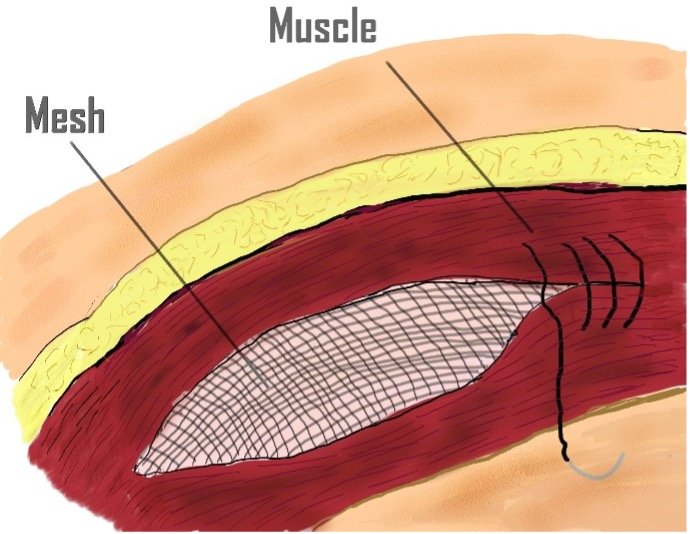
I sometimes compare this with repairing a damaged plaster wall. Simply pulling weak edges together may not give you a strong repair.
A reinforcing layer is placed behind the weak area, then the abdominal-wall layers are brought together over it where possible.
In abdominal wall reconstruction, that reinforcing layer is mesh.
How mesh may reinforce the abdominal wall
Why might mesh be used?
The tissues in a major incisional hernia may be stretched, scarred and weak. I use mesh to add reinforcement rather than relying on stitches alone.
There are lots of different meshes available. I put a lot of thought into which mesh is most appropriate for each reconstruction.
What types of mesh might be used?
One useful way of understanding mesh is to think about whether material is designed to remain permanently or be gradually absorbed.
Some mesh material is designed to gradually break down and be absorbed rather than remain permanently.
This can be useful in selected situations, particularly where the condition of the tissues or contamination affects my choice.
Other mesh materials are designed to remain in the abdominal wall and provide long-term reinforcement.
Some modern products also combine different materials, so the categories are not always quite as simple as they sound.
You do not need to remember product names or work out which mesh you want. The useful question is why I recommend a particular mesh and position for your abdominal wall.
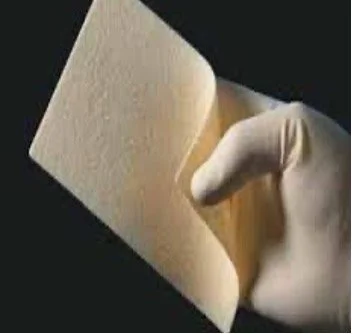
What do different meshes actually look like?
You do not need to choose a mesh yourself. These pictures are here so you can see what I mean when I talk about different mesh materials.
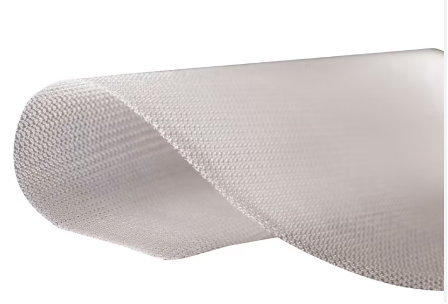
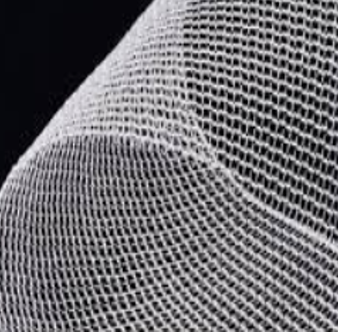
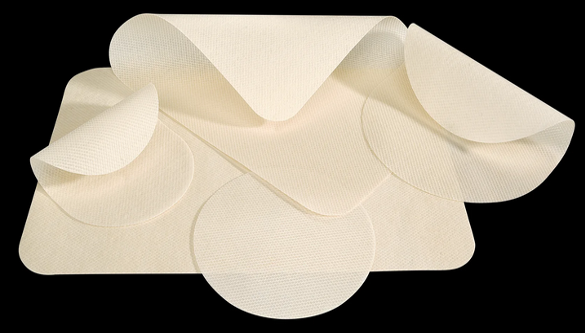
Does mesh have risks?
Yes. Like any implanted medical device, mesh has recognised risks.
These include problems such as infection, erosion, movement from its original position and chronic pain. Some mesh problems can require further treatment or another operation.
We deal with these risks properly in Chapter 5: Understanding my operation and risks.
What if the muscles will not come together easily?
These are specialist techniques for selected complex reconstructions. Seeing them here does not mean you will need them.
Botox Helps relax and lengthen abdominal-wall muscles before surgery
Botox can also be injected into the muscles of the abdominal wall.
In selected large hernias, relaxing the muscles allows them to lengthen and can make it easier to bring the abdominal wall back towards the middle during surgery.
If I think this would help you, I will explain why it is being recommended and how it fits into your plan.
Component separation Releases part of the abdominal wall so the muscles can move further
The abdominal wall contains several muscle layers. Sometimes the main muscles are simply too far apart to bring safely back to the centre.
Component separation means releasing part of the abdominal wall to give the muscles more movement.
Depending on the reconstruction, this may be performed through the main operation or with smaller keyhole incisions.
The aim is to reduce tension and help rebuild the middle of the abdominal wall.
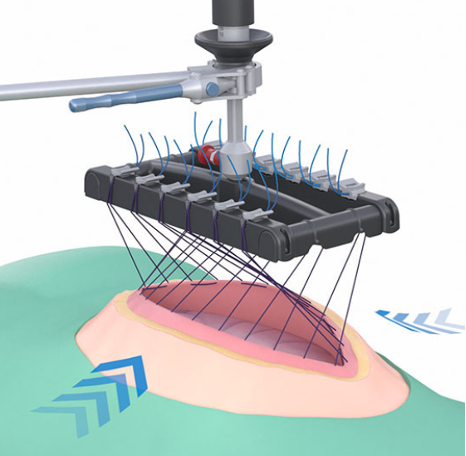
Fasciotens Applies controlled traction to abdominal-wall tissue
Fasciotens is a mechanical tensioning device.
It applies controlled traction to the abdominal wall, gradually stretching the tissues so that the edges can come closer together.
It is not part of a routine hernia repair. I use specialised tools like this when the abdominal wall is particularly difficult to close.
What Fasciotens looks like
It looks unusual, but its job is relatively simple: applying controlled traction to the abdominal wall.
Chronic pneumoperitoneum Gradually creates more room inside the abdomen before reconstruction
In a very large loss-of-domain hernia, the abdominal contents may have been outside their normal space for so long that the abdomen itself has become too small.
One specialised option is to place a small tube into the abdominal cavity and repeatedly introduce air over a period of time before the definitive reconstruction.
This gradually increases the capacity of the abdomen and stretches the abdominal wall.
This is an intensive treatment reserved for selected very complex cases.
ABRA Gradually brings a very difficult open abdomen together
ABRA is a specialised dynamic closure system. You can think of it as a surgical corset that gradually brings the abdominal wall together.
In the situations where I use it, the abdomen is closed progressively rather than forcing everything together in one step.
This can mean remaining asleep and supported on a ventilator in intensive care while the abdominal wall is gradually brought together.
This is only relevant to a small number of exceptionally difficult reconstructions.
What an ABRA closure can look like
This is a real clinical image. It is here only if you want to see what the device looks like in use.
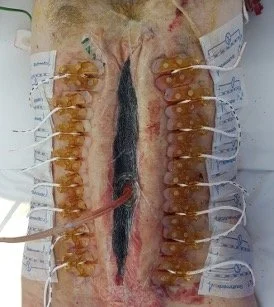
More than one operation Some abdominal walls are safer to reconstruct in stages
If there is significant infection, an open wound, bowel problems or a stoma, trying to solve everything in one operation may not be the safest plan.
I may recommend a staged reconstruction involving more than one operation.
In particularly complex situations, you may remain in hospital between stages.
Plastic-surgical flap reconstruction Used when abdominal-wall tissue has been severely lost
Occasionally there has been such severe loss of abdominal muscle and skin that the abdominal wall cannot be closed using the remaining local tissue.
In this situation I may work with plastic surgeons who can move skin and muscle from another part of the body, such as the thigh or back, to reconstruct the defect.
This is a specialised option for major tissue loss rather than a routine part of hernia surgery.
I have included them so the words are less mysterious if you hear them during your consultation. I will explain which parts are relevant to your abdominal wall and which are not.
What might happen to the shape of my abdomen?
With a major incisional hernia, putting the bowel back inside the abdomen can leave a large amount of stretched or hanging skin.
For some people, dealing with that skin is part of the reconstruction rather than a separate cosmetic operation.
This is also an area where expectations matter. I want to talk about function, scars and body shape before surgery, rather than have you surprised by them afterwards.
What is an abdominal apron or pannus?
A pannus is a large fold or apron of lower abdominal skin and fat.
It may develop after major weight change, pregnancy or prolonged stretching of the abdominal wall.
A very large apron can affect movement, balance, skin health and toileting. It can also make abdominal-wall reconstruction more difficult.
If the apron is removed as part of reconstruction, this is called an apronectomy or panniculectomy.
Can a tummy tuck be done with the hernia repair?
When significant lower abdominal skin is removed during reconstruction, you may hear terms such as apronectomy, panniculectomy or abdominoplasty.
A long incision is usually made across the lower abdomen. Excess skin and fat are removed and the upper skin is brought down to meet the lower edge.
For a large apron this can itself be a substantial part of the operation. I will explain whether removing excess skin is useful for the reconstruction you need.
What is a Fleur-de-Lis abdominoplasty?
Fleur-de-Lis, often shortened to FDL, is useful when there is a large amount of loose skin both across the lower abdomen and vertically through the middle.
Skin is removed in both directions. The final scar usually has an inverted-T shape, with a horizontal lower-abdominal scar and a vertical scar through the middle.
The trade-off is a more visible scar in exchange for removing more redundant skin and helping with selected large reconstructions.
The belly button may also need to be changed or removed.
What a Fleur-de-Lis operation can involve
These three images show the sequence from before surgery, through the planned skin removal, to the result six months afterwards.
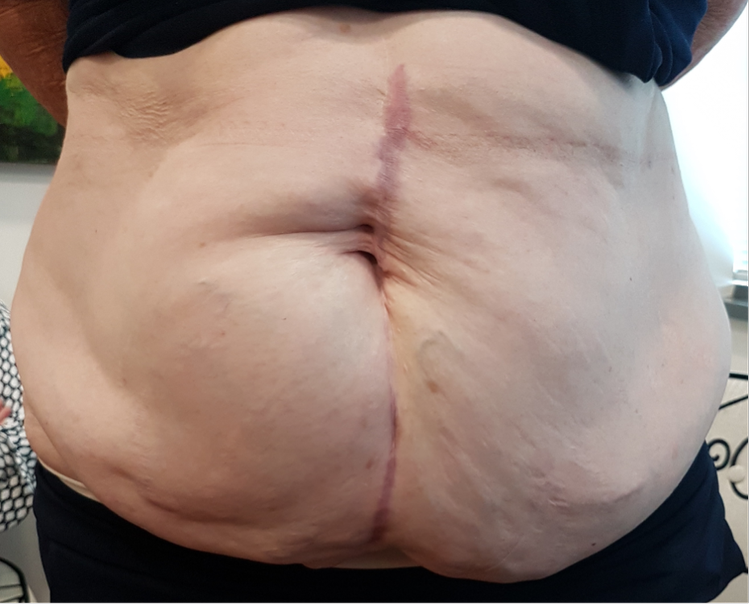
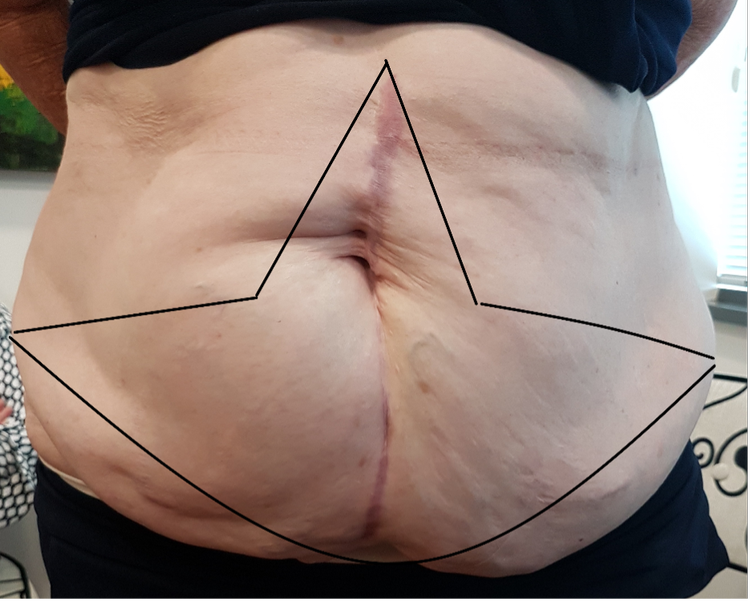
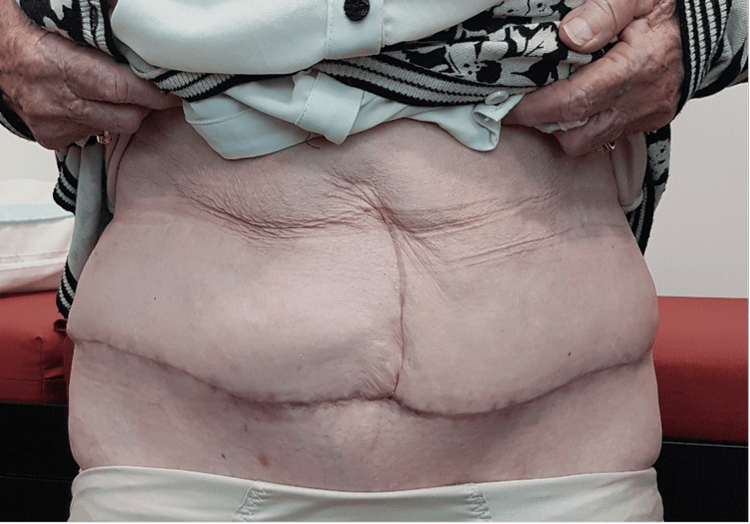
What is an anchor-shaped incision?
In some large reconstructions an anchor-shaped incision is needed to repair the hernia and remove excess skin.
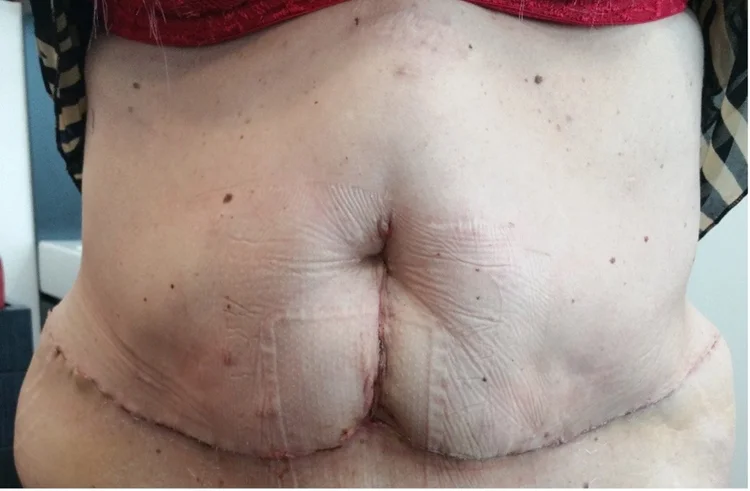
Will my abdomen be flat afterwards?
Not always.
Removing a lower abdominal apron can tighten the skin, but it does not remove all the fat from the upper abdomen or the fat stored inside the abdomen around the organs.
This means the lower abdomen may be much smaller while the upper abdomen still has a rounded shape.
Tissue quality matters as well. Muscles and skin that have been stretched for many years cannot always be returned to the shape they had when you were younger.
I would rather be realistic with you about this before surgery than have you surprised afterwards.
Could the new shape of my abdomen affect how clothes fit?
Yes. If a large apron is removed, the proportions of your abdomen can change considerably.
Trousers, skirts and waistbands may sit differently because the lower abdomen is no longer the same shape.
You will also be swollen after surgery and your shape will continue to change as that swelling settles.
What will happen to my belly button?
It does not have an essential function in adult life, but for many people it is important to how their abdomen looks.
Depending on the hernia, scars, blood supply and amount of skin being removed, there are three broad possibilities:
- keep your existing belly button
- remove it
- remove it and create a new one, either during the reconstruction or later
Keeping a belly button with poor blood supply can result in it failing to heal or losing its blood supply.
I will discuss what is realistically possible before surgery.
What can the abdomen look like without a belly button?
This postoperative photograph shows one example after abdominoplasty where the belly button has been removed.
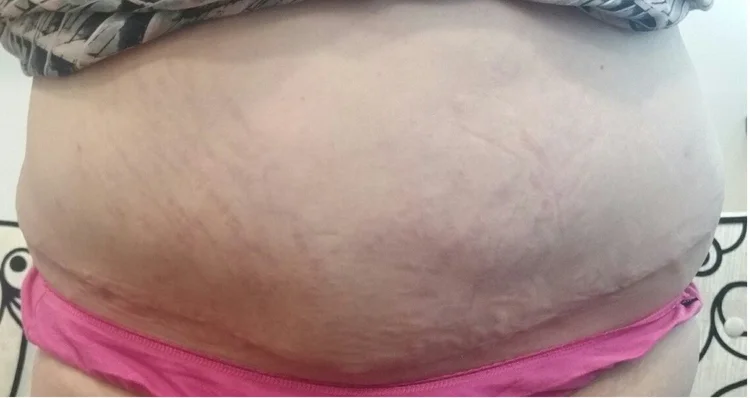
Why does the mons matter?
The mons is the pad of skin and fatty tissue over the pubic area.
A large abdominal apron can cover this area for years. Once the apron is removed, the mons can suddenly look much more prominent.
It can also become quite swollen after reconstruction because the tissues have been moved and tightened. That swelling can take months to settle.
I may reshape the mons as part of the operation. Occasionally further adjustment is considered later.
What about loose skin on my thighs or arms?
If you have lost a large amount of weight, removing the abdominal apron can make loose skin elsewhere more noticeable, particularly around the inner thighs.
Excess skin may also remain under the arms.
These areas are separate from abdominal-wall reconstruction. If they are important to you, we can discuss them separately rather than assuming they are part of the hernia operation.
Will my stretch marks disappear?
Stretch marks disappear only if the skin containing them is actually removed.
Marks in skin that remains after reconstruction will still be there. Surgery cannot remove every stretch mark.
What if I also have a divarication or diastasis?
A divarication, also called a rectus diastasis, is a widening or separation between the central abdominal muscles without a true hernia defect.
It can occur after pregnancy, obesity or long-term stretching of the abdomen and can exist alongside an incisional hernia.
What does a divarication look like?
The central muscles are still present, but the space between them has become wider.
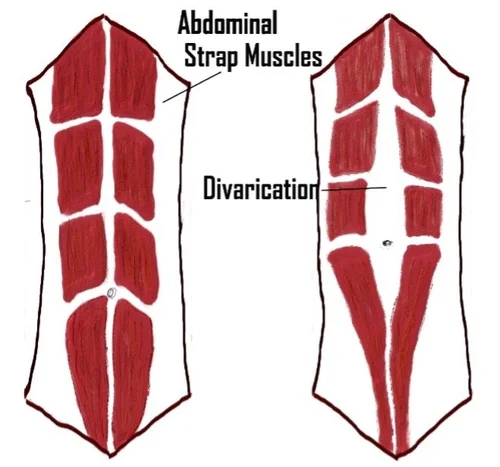
A divarication can produce quite a noticeable bulge, particularly when the abdominal muscles are being used. That can make it look similar to a hernia even though the underlying problem is different.
What can a divarication look like?
This is a real clinical example. The appearance can vary considerably from person to person.
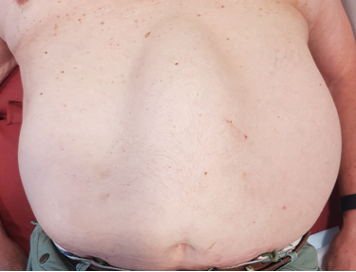
When an abdominoplasty and hernia reconstruction are being performed, I may repair a significant divarication as part of rebuilding the abdominal wall.
A divarication on its own is different from a true hernia and does not automatically need an operation.
This is reconstruction, not a promise of a perfect abdomen
The aim is to improve abdominal-wall function, support and body shape where this can safely be achieved.
I cannot turn tissues that have been stretched, scarred or operated on repeatedly back into untouched tissue.
Before surgery, we will discuss the likely scars, the expected shape of your abdomen and whether your skin, belly button or other structures are likely to change.
The operation is designed to reconstruct the abdominal wall, not simply remove a lump.
I may need several techniques to bring widely separated muscles together.
Mesh reinforces the reconstruction, but its type and position are chosen for your individual operation.
Skin removal can sometimes be part of reconstruction, but scars and body shape need realistic discussion.
Which parts of this apply to me?
You are not expected to understand every surgical technique. Save the questions that would help you understand the plan for your abdominal wall.
Saved on this device. Nothing is sent automatically. You can review your questions or choose to open them in your own email app from My Questions.
What can I do before surgery?
With major abdominal wall reconstruction, what happens before the operation can be just as important as the operation itself.
This is not just waiting for surgery
I know it can be frustrating to hear that you need to lose weight, stop smoking, improve your diabetes or get fitter before I operate.
I am not asking you to do these things just to make you jump through hoops. Abdominal wall reconstruction can be major surgery, and I want to improve the things we can improve before asking your body to recover from it.
What can lower my risk before surgery?
Not every item below will apply to you. I will help you decide which areas matter most in your situation.
Why does my weight matter?
One of the important risk factors for developing an incisional hernia is obesity.
BMI is not a perfect measure of obesity, but it does tell me something useful about your surgical risk.
What risks increase when BMI is over 35?
Being overweight, particularly with a BMI over 35, increases the risk of:
- developing a hernia
- having a more difficult hernia repair
- the repair failing
- infection and blood transfusion
- heart attacks and chest infections
- clots in the legs
- serious complications, including death
Why can weight loss make the operation easier?
Weight is not only stored around the hips, thighs or under the skin.
There is also fat inside the abdomen around the organs. As you lose weight, some of that internal fat reduces too.
This is especially important when a large amount of bowel is sitting outside the abdominal cavity because losing internal abdominal fat can make it easier to return the bowel to where it belongs.
Losing weight is hard. I have put the fuller discussion of weight, diet, medicines and weight-loss surgery into a separate companion guide so you can go into as much detail as you need.
Smoking is bad too
Smoking is strongly associated with poor wound healing and failure of the repair. If I am asking your body to heal after high-risk surgery, stopping smoking is one of the most important things you can do to lower that risk.
You need to stop smoking at least one month before the operation.
You should arrive at surgery smoke-free.
You need to remain smoke-free for at least two months afterwards.
What about nicotine patches and vaping?
Nicotine patches are OK to use before surgery.
I do not regard electronic cigarettes or vaping as an acceptable alternative to smoking for this operation. You should stop these before surgery as well.
If you are finding this difficult, speak with your GP or a smoking-cessation service. Ask for help rather than trying to hide it.
Will you check whether I have stopped?
If you have been a smoker, I may use a urine test before surgery to check that there are no traces of cigarette smoke exposure in your body.
If I smoke, when do I need to stop before reconstruction?
This is a self-check only. Your answer is not saved or sent anywhere.
How well controlled does my diabetes need to be?
Good control of diabetes is important before major surgery because it helps reduce wound infection and supports healing.
This is the level I currently want before major abdominal wall reconstruction.
I will check your HbA1c, which is a blood test that gives us an idea of your average diabetic control.
If your HbA1c is over 7, I will ask you to see a diabetes specialist so we can improve it before surgery.
How much exercise should I try to do?
Light exercise before surgery can help reduce the risk of complications afterwards.
Try to walk at a moderate pace every day.
I understand that this simply is not possible for some people with a large hernia. That does not mean you have failed. Any physical activity helps.
Walk around the block. Even ten minutes helps.
Use an exercise bike or treadmill while watching TV.
Try water exercise in a swimming pool.
Use your phone or fitness watch to remind you to walk or take some deep breaths.
See a physiotherapist or gym trainer if you need help finding something realistic.
What should I do about food and supplements?
Your body relies on what you put into it to heal. Good nutrition is therefore an important part of preparing for major reconstruction.
What should I be eating?
Eat a healthy, balanced diet before surgery.
High-protein food just before surgery is particularly important because your body needs protein to heal.
Healthy eating is much more complicated than simply avoiding fatty foods. I recommend seeing a dietitian before abdominal wall reconstruction so you understand what your body actually needs.
I recommend returning to a normal, well-balanced diet for the week before your operation.
What about snoring or sleep apnoea?
Sleep apnoea is common in people who are overweight and it matters when you are having major surgery.
If you snore and have not had a sleep study, I may order one. If you need CPAP, treating sleep apnoea before the operation can help reduce your operative risk.
Why can breathing be difficult after reconstruction?
People with large incisional hernias can become what I sometimes call lazy breathers because the abdominal wall is not working normally.
After reconstruction, the abdominal wall is tighter and the diaphragm, the muscle between your chest and abdomen, has to do much more of the work of breathing.
It can take time for that muscle to become strong again. This is one reason I pay so much attention to breathing, fitness and sleep apnoea before surgery.
What tests might I have before surgery?
Planning an incisional hernia repair can require several tests. I need to understand both your abdominal wall and whether you are medically and physically fit for an operation of this size.
1. Blood tests
These may include a full blood count and kidney and liver function tests.
If you have diabetes, I will check your HbA1c and I currently want this to be less than 7.
I may also check vitamin levels.
If you have been a smoker, I may arrange a urine test to check for evidence of cigarette smoke exposure.
2. CT scan of the abdomen
A CT scan lets me inspect the muscles of the abdominal wall and measure how far apart they are.
It also helps me see how much bowel is outside the abdominal cavity and plan how difficult it may be to return everything to the abdomen.
The scan may also identify other problems in the abdomen, such as gallstones or an unexpected mass.
3. Ultrasound of the abdomen
Ultrasound is particularly useful for looking for gallstones.
If you have gallstones, I will discuss whether your gallbladder should also be removed at the time of your abdominal wall surgery.
4. Colonoscopy
Depending on your circumstances and previous bowel investigation, I may recommend a colonoscopy before major reconstruction.
The purpose is to make sure there is not an important bowel problem that should be identified before we undertake a large abdominal operation.
5. Heart and lung tests
These tests help me assess whether your heart and lungs are ready for major surgery.
Depending on your age and health, this may include an ultrasound of the heart, lung-function tests, a sleep study or exercise testing.
I may also ask a heart or lung specialist to assess you.
The strain after reconstruction can be particularly significant if your BMI is over 50 or if a large volume of bowel has been living outside the abdominal cavity.
Please tell me about everything you take
Bring an up-to-date list of your prescribed medicines, injections, over-the-counter medicines and supplements.
Some medicines need an individual plan around major surgery, particularly blood thinners, diabetes treatment and some weight-management medicines.
What about blood clots and an IVC filter? This is an individual decision, not something everybody needs.
Major abdominal surgery can increase the risk of blood clots forming in the legs. A clot can break off and travel to the lungs, where it can be life-threatening.
I discuss an IVC filter in selected patients when clot risk is an important concern.
I describe it as being a little like an open-ended birdcage. It is placed in the large vein carrying blood from the legs towards the heart and lungs.
It does not stop a clot forming. Its purpose is to try to stop a large clot travelling to the lungs.
The filter is usually inserted through a vein in the leg or neck in the X-ray department and needs to be removed later.
What do I need to have sorted?
Things I want to be clear about
Use this as your own reminder. Not every item applies to everybody, and ticking these boxes does not mean I have medically cleared you for surgery.
Stored on this device only. This is a personal reminder, not a medical assessment or confirmation that you are ready for surgery.
If your BMI is over 40, expect weight loss to be part of preparation.
You need to stop smoking one month before and two months after surgery.
If you have diabetes, I currently want your HbA1c below 7.
Aim for 20–30 minutes of moderate walking each day if you can, but even small amounts of activity help.
Good nutrition, sleep-apnoea treatment and completing the required tests are part of getting ready for reconstruction.
What do I personally need to improve?
Save the questions that will help you leave your consultation with a clear preparation plan.
Saved on this device. Nothing is sent automatically. You can review your questions or choose to open them in your own email app from My Questions.
What could go wrong?
This is major surgery. I want you to understand the important risks before we decide together whether the expected benefits are worth those risks for you.
Your risk is individual
A long list of complications can look frightening when you read it all at once. The point is not that I expect all of these things to happen.
The point is that abdominal wall reconstruction can involve bowel, mesh, scarred tissue, major wounds and sometimes a large change in the pressure inside your abdomen.
Your own risk depends on your hernia, your previous operations, your weight, diabetes, smoking, other medical problems, whether there is a stoma or infection, and how much of your abdominal contents are outside the abdomen.
Earlier you said these things matter to you
You have not saved anything in “What matters to me” yet.
It is completely reasonable if what matters to you changes after reading more about the operation and its risks.
Start with the big picture
These are not the only possible complications, but they are some of the most important ones to understand before a major reconstruction.
My booklet uses approximately 20–30% as the overall recurrence figure for incisional hernias and notes that my own recurrence rate is lower than this.
Your individual risk may be higher or lower.Mesh infection may require another operation and removal of the infected mesh.
Infection can occur early or much later.Wound infection can range from a relatively straightforward wound problem to a much more difficult complication.
Risk depends on the operation and your health.This is the approximate general figure in my current booklet for this type of operation.
The risk can be substantially higher in very complex cases.Can the hernia come back?
Yes. No abdominal wall reconstruction can guarantee that the hernia will never return.
The mesh can pull away from the edge of the repair and a new defect can develop. The more times a hernia has already been repaired, the more difficult the next repair becomes and the greater the risk of another recurrence.
What makes recurrence more likely?
In my booklet I identify several factors that can increase the chance of the hernia returning:
- obesity or significant weight gain
- diabetes
- smoking
- wound infection
- a weakened immune system
- multiple previous hernia repairs
This is one reason the preparation we discussed in Chapter 4 matters.
Will I have permanent lifting restrictions?
Normal daily activity is important and I do not want you frightened of ordinary movement.
My current booklet does, however, advise that very heavy lifting such as moving pianos or furniture should remain off limits after abdominal wall reconstruction.
I will give you more specific advice about returning to activity as you recover.
If my abdominal wall is reconstructed successfully, can the hernia still come back later?
This is a self-check only. Your answer is not saved or sent anywhere.
Why can the bowel be injured?
Previous abdominal operations create scar tissue called adhesions. The bowel can become densely stuck to the abdominal wall, old mesh or other bowel.
During reconstruction I have to carefully separate those structures. The bowel can tear during that process.
What if part of the bowel needs to be removed?
Sometimes bowel is so involved with old mesh, scar tissue or a fistula that I need to remove a section.
The bowel is then joined back together. Like any bowel join, that join can leak.
What is a fistula?
A fistula is an abnormal opening from the bowel. Bowel contents can leak through the abdominal wound or into the abdomen.
This is a major complication. It may require another operation and can mean many weeks in hospital.
A bowel perforation can occasionally become life-threatening or fatal.
If the bowel is injured during surgery, could that change the reconstruction?
This is a self-check only. Your answer is not saved or sent anywhere.
What problems can happen with mesh?
Mesh gives the reconstructed abdominal wall additional strength, but like any implant it has its own possible complications.
Mesh infection
My current booklet gives a mesh-infection risk of approximately 2–5%.
Infection can occur in the first few weeks or can occasionally present years later.
If mesh becomes infected, it may need to be removed at another operation.
Mesh erosion or exposure
Mesh can occasionally erode into nearby structures such as bowel, bladder or skin.
Mesh may also become exposed through the skin. These problems can cause infection and may require further surgery and mesh removal.
Mesh migration
Mesh can pull away from an edge of the repair or move from its intended position.
This can contribute to recurrence or, rarely, mesh can end up involving the bowel, bladder or another organ and require further surgery.
Chronic mesh-related pain
A small proportion of patients can develop chronic pain associated with mesh.
Occasionally this becomes significant enough to need specialist pain treatment or further surgery.
What can happen to the wound?
These operations often involve long scars and tissues that have already been cut through several times.
Wound infection
My current booklet gives a wound-infection risk of approximately 4–10%.
Some infections can be managed relatively simply. Others can become more complicated, particularly when mesh is involved.
Loss of skin
Multiple previous scars can damage the blood supply to the skin.
Another major incision can occasionally cause an area of skin to lose its blood supply and die.
If this happens, treatment can involve weeks of wound dressings, vacuum-assisted dressings, skin grafts or further plastic surgery.
Numbness, blisters and scarring
There will be numbness around a large surgical wound, and some of this can be permanent.
Some people react to surgical dressings and can develop blisters or additional scarring.
Abnormal or keloid scars can also occur.
What is abdominal compartment syndrome?
In some very large hernias, returning the bowel to the abdomen and closing the abdominal wall can make the abdomen extremely tight.
That pressure can reduce blood flow to the bowel and kidneys and can make breathing very difficult.
What might happen if this occurs?
The kidneys can stop working and breathing may require prolonged support with a ventilator in intensive care.
If ventilation is needed for a prolonged period, a tracheostomy may be required.
In severe cases the abdomen may need to remain open or be reopened and closed more slowly later.
This risk becomes particularly important in very large loss-of-domain hernias.
Other risks I discuss in my booklet
You do not need to memorise this list. Open the areas that are useful to you and save a question if something concerns you.
Bowel obstruction
Bowel can stick to mesh or scar tissue and cause a bowel obstruction.
This is uncommon, but the risk can remain lifelong.
Persistent or chronic pain
Pain and discomfort are expected for days or weeks after a major reconstruction.
Occasionally a nerve becomes trapped in scar tissue and pain can persist long term. This may require treatment from a pain specialist and can affect lifestyle.
Meralgia paraesthetica
It causes numbness, tingling or pain over the outer part of the thigh.
Swelling around the abdominal wall can compress the nearby nerve. In my booklet I explain that this is usually temporary but may take one to two months to completely settle.
Problems from mesh tacks
Metal or absorbable tacks are sometimes used to hold mesh in place.
Rarely, a tack can erode into structures such as bowel, muscle, bladder or skin and cause further problems.
A surgical drain can break
A drain can very rarely break while it is in the wound. Further surgery may be required to remove the retained part.
Are there additional risks?
Yes. All the risks already discussed still apply, but keyhole or robotic surgery has some additional considerations.
Risks that are not unique to the hernia repair
Major surgery and a general anaesthetic carry risks of their own. These are important even though they are not specific to abdominal wall reconstruction.
Can someone die from this operation?
Yes. This is major surgery and I do not think it is helpful to pretend otherwise.
The higher figure does not apply to every patient. It describes particularly difficult situations such as very large loss-of-domain hernias, major obesity or a very wide abdominal-wall defect.
This is exactly why I spend so much time assessing your fitness, your abdominal anatomy and whether the timing is right before recommending reconstruction.
Does the 1 in 1,000 figure mean every patient has exactly the same risk of dying?
This is a self-check only. Your answer is not saved or sent anywhere.
A risk is something that could happen, not something I expect to happen
My job is not simply to hand you a list of complications. It is to explain which risks are particularly relevant to you, how serious they could be, what we can do to reduce them and what benefit we are trying to achieve by taking those risks.
If something here changes how you feel about reconstruction, that is important. Save the question and bring it back to me.
Major abdominal wall reconstruction has real and sometimes serious risks.
A successful repair can still recur later.
Bowel injury, wound problems and mesh complications can sometimes mean further surgery or a long hospital stay.
Very large loss-of-domain hernias can carry much higher risk than less complex reconstructions.
The important question is what these risks mean for you and whether the expected benefit makes them worth taking.
What are my risks?
The general numbers are only the starting point. These questions help us make the discussion personal to you.
Saved on this device. Nothing is sent automatically. You can review your questions or choose to open them in your own email app from My Questions.
What happens when I come into hospital?
Knowing what will happen before, during and immediately after surgery can take away some of the mystery. I am going to talk you through it.
This is usually a proper hospital stay
For major abdominal wall reconstruction, you will typically be in hospital for around 7–10 days.
Some people need less time. Others, particularly those having a very complex or staged reconstruction, may need considerably longer.
You can usually expect to see me every weekday. On weekends, or if I am dealing with urgent surgery elsewhere, one of my practice partners may see you. We commonly assist one another with this type of surgery.
Before you arrive
Want to see the admission process?
I have made a short video showing the admission process. Watching it is completely optional. The important written information is also included below.
The video is optional and does not replace the individual admission instructions sent to you before surgery.
Please complete your admission with Greenslopes Private Hospital at least 48 hours before you are due to come into hospital.
You can do this online through the Greenslopes Private Hospital admission page. Choose General admission and complete the hospital's online admission form.
We will usually email you approximately 2–3 days before admission to confirm your admission time and your individual fasting instructions.
Please reply so we know you have received and understood the instructions.
On arrival at Greenslopes Private Hospital, present to Admissions at the designated time.
Admissions is on Level 1. From the main entrance, the pharmacy is on the left. The lift is at the end of the pharmacy.
If the location in your individual admission instructions is different, follow the instructions sent to you.
Bring all your current medicines in their original packaging, along with the things you will need during your hospital stay.
Why do I have to stop eating and drinking?
When you have a general anaesthetic, the muscles in your body relax. If there is food or fluid in your stomach it can come back up and enter your lungs.
That can cause a very serious pneumonia, which is why fasting instructions matter.
What are the usual fasting rules?
For an arranged operation, six hours without food is the usual general rule I use.
Your own fasting instructions may be different and the individual times sent to you always take priority.
For some major operations, the anaesthetist may also prescribe a sugary carbohydrate drink closer to surgery.
Do not chew gum before surgery because this can increase fluid in the stomach.
You can brush your teeth.
Some regular medicines can be taken with a sip of water, but any specific instructions you have been given about blood thinners, diabetes medicines, weight-loss medicines or another drug take priority.
Which fasting instructions should I follow?
This is a self-check only. Your answer is not saved or sent anywhere.
What should I bring?
All current medicines in their original packaging.
Comfortable pyjamas and a robe for when you are up and around.
Your usual toiletries.
Books, laptop, tablet or something else to occupy yourself.
Chargers for your devices.
Avoid bringing large amounts of cash or valuable items.
What about hospital and other fees? Some services may bill separately.
When you book surgery, we will provide an estimate of my surgical fee and the assistant's fee.
Your anaesthetist is separate from our practice and may have their own out-of-pocket fee. You are entitled to ask the anaesthetist about this before surgery.
Imaging, pathology and pharmacy services used during your hospital stay may also be separate providers and may create additional costs depending on your private health cover.
What happens before I go to sleep?
Having a general anaesthetic can be very scary for some people. It brings up issues about loss of control. People worry about what might happen while they are asleep.
Having an anaesthetic involves a lot of trust. In the end, you have to take a little leap of faith and believe that you have chosen a team who will look after every part of you.
For some people, knowing exactly what goes on in theatre actually makes the whole thing much less frightening.
Your paperwork is completed, your next of kin is confirmed and your observations are checked.
A pre-op nurse will help you change into your glamorous theatre gown, paper underwear and the other very fashionable items required for surgery.
You will be asked your name, date of birth and operation several times. By the end you will be extremely good at it.
And wait. And wait. Hospital delays happen because unexpected things happen. Bring something to do.
An orderly or nurse will take you around to theatre. This is usually where you say goodbye to the person who has come with you.
What happens to my clothes and underwear?
For major abdominal surgery it is best to remove your normal clothes, including your bra and underwear.
This stops them being lost or covered in antiseptic, blood or other fluid during surgery.
Hospital gowns wrap around you and we make every effort to preserve your modesty.
For abdominal operations your paper underwear may need to be removed after you are asleep because it can be in the operative area. You may therefore wake up without it, covered by your gown and blankets.
Your clothes, glasses and belongings are stored safely and returned when you reach the ward or ICU.
What happens in the anaesthetic room?
You will have another identity check, the consent form will be checked and I will mark the operative area.
They will review your medical history and talk through what to expect.
The main thing that usually needs to go into you while you are awake is a small plastic tube in a vein, called a cannula, drip or IV.
The needle is removed once it is in place. Only the soft plastic tube stays in the vein.
If an epidural is planned for pain relief, that may also be placed before you go to sleep.
What if I have a terrible fear of needles?
Tell us.
A severe needle phobia is very real and one small needle can create enormous anxiety.
In selected situations, the anaesthetist may be able to start the anaesthetic with gas so you drift off to sleep before the IV is inserted.
It is slower, but for some people it makes a huge difference.
What will the operating theatre actually look like?
Theatre can be quite confronting the first time you see it.
There may be around five to ten people in the room, everyone is wearing theatre clothing and masks, and there can seem to be a lot happening at once.
There will be an anaesthetic machine and monitors, tables of surgical instruments and nurses preparing equipment. The operating table is in the middle of the room under large theatre lights.
The table is narrow because we need to stand close to you while operating. It may initially feel cold, but you will be kept warm during surgery.
We will also place padded supports around you and usually use compression devices on your legs to reduce the risk of blood clots.
I think of it in three phases
You breathe oxygen through a mask and the anaesthetic medication is given through your IV. You are usually asleep within seconds.
The anaesthetic machine breathes for you and your anaesthetist stays with you, continuously watching your breathing, heart rate, blood pressure and other vital signs.
At the end, the anaesthetic is reduced, pain relief is given and you begin breathing for yourself again before going to recovery.
What happens to my breathing while I am asleep?
Once you are asleep, medication is used to relax your muscles for major abdominal surgery.
The anaesthetist places a breathing tube into your windpipe and the anaesthetic machine breathes for you.
Your anaesthetist has assessed your airway beforehand and has different equipment and strategies available if placing the tube looks as though it may be difficult.
Occasionally the breathing tube can leave a sore or dry throat afterwards. Damage to teeth or lips is uncommon but can occur.
How do you know I am safe while I am asleep?
You are connected to several monitors before the operation starts.
These monitor things such as your heart rhythm, pulse, blood pressure, oxygen level and depth of anaesthesia.
You may notice stickers on your chest and forehead, a pulse monitor on your finger and a blood-pressure cuff around your arm.
Your anaesthetist remains with you throughout the operation and continually adjusts fluids and medicines as required.
What happens after the operation?
The recovery room is the first thing most patients remember after going to sleep.
Your family cannot usually come into recovery because there are other patients there and their privacy needs to be protected.
With your permission, I will contact your nominated family member after the operation. The recovery team can also let them know when you are ready to return to the ward.
What should I expect at first?
When you return to the ward you may be drowsy, nauseated or sore. None of that is unusual after major surgery.
Your nurses will regularly check your pulse, blood pressure, temperature, breathing, pain and dressings.
If you are receiving strong pain medicines such as morphine or fentanyl, you may need to wear oxygen while they are being used.
What if I need intensive care? Particularly relevant to some of the most complex reconstructions.
Some patients having very large or complicated abdominal wall reconstruction need intensive care after surgery.
ICU can be a strange and sometimes stressful place. It operates 24 hours a day and there is much less distinction between night and day.
Sleep can be badly disrupted. Some people become confused, irritable or low in mood.
If you have needed a ventilator, you may remember periods when sedation was being reduced. Some patients describe feelings of helplessness or loss of control.
Strong pain medicines can also occasionally contribute to dreams or frightening hallucinations which feel very real at the time.
Questions you may be too embarrassed to ask
These questions come up far more often than you might think. There is very little you can ask us that we have not heard before.
What if I have my period on the day of surgery?
It makes no difference to us. Having a period is a normal part of life.
I suggest using a pad rather than a tampon because it may be some time before you can change it.
Ask the admission nurse if you need anything.
What if I need to pee or wet myself?
Feeling as though you need to pass urine just before theatre is very common and can simply be anxiety.
For a large operation, we will usually place a urinary catheter after you are asleep so urine drains continuously.
And yes, occasionally somebody wets themselves during an operation.
What if my bowels work while I am asleep?
This is uncommon.
If it happens, you will be cleaned before you are moved to recovery. It really is not something you need to be embarrassed about.
What if I think I might be pregnant?
Tell us when you check in, even if you are only suspicious.
If there is a possibility of pregnancy we can arrange a pregnancy test if required.
A planned operation may need to be delayed because surgery and anaesthetic medicines can create risks for a pregnancy.
I always vomit after an anaesthetic. Will it happen again?
Nausea and vomiting can happen after anaesthesia and can be particularly unpleasant if you have experienced it badly before.
It is more common in people who suffer from motion sickness.
Tell your anaesthetist about your previous experience. There are several strategies they can use to reduce the risk.
What if I am breastfeeding?
Breastfeeding should not stop you from having surgery that you need.
Tell your anaesthetist that you are breastfeeding. They can give you current advice about the medicines being used and when feeding can safely resume.
It is also sensible to think ahead about feeding your baby while you are in theatre and during your early recovery.
Who will be in theatre with me?
Several people are needed to look after you safely.
In addition to me and your anaesthetist, there may be other surgeons or junior doctors, theatre nurses, anaesthetic staff, orderlies and sometimes X-ray staff.
Greenslopes is a teaching environment, so medical students may also be present.
Staff may be male or female. There are times when part of your body needs to be exposed while you are positioned or prepared for surgery, but we make every effort to protect your dignity and modesty.
What if I wake up during the operation?
Awareness during a general anaesthetic is exceptionally rare.
Keeping you appropriately asleep is one of the anaesthetist's central jobs. Your anaesthetic and vital signs are continuously monitored throughout the operation.
If this is a particular fear for you, tell your anaesthetist. It is absolutely reasonable to talk about it.
I take the contraceptive pill. Does that matter?
Tell your anaesthetist that you take oral contraception.
Some medicines used around anaesthesia can affect the reliability of hormonal contraception.
If a relevant medicine is used, your anaesthetist will tell you whether additional contraception is required and for how long.
I am worried about my memory after the anaesthetic
Some people, particularly older patients, can experience confusion or changes in thinking after major surgery and anaesthesia.
If memory or cognition is a particular concern for you, tell your anaesthetist before surgery so they can discuss your individual risk.
Being nervous before surgery is normal
Every person experiences some anxiety. Having a major operation is a significant life event.
Anxiety becomes a problem when it overwhelms you, stops you sleeping, creates a constant stream of frightening thoughts or produces physical symptoms such as nausea, headaches or chest discomfort.
Complete your online hospital admission and look out for the email with your individual instructions.
Follow your own fasting and medicine instructions.
Theatre can look busy and confronting, but every person in the room has a job in keeping you safe.
Tell us about fears such as needles, nausea, awareness or anxiety.
After major reconstruction, a hospital stay of around 7–10 days is typical, but complex cases can take longer.
Is there something about hospital or anaesthesia worrying me?
It is completely reasonable to ask about the practical, personal or embarrassing things as well as the operation itself.
Saved on this device. Nothing is sent automatically. You can review your questions or choose to open them in your own email app from My Questions.
What will recovery really be like?
This is major abdominal surgery. Recovery is not a straight line and it does not happen in a week or two. I want you to know what is normal, what may take time, and when I want you to get in touch.
Good results take time
Abdominal wall reconstruction is not an operation where you wake up, look down and immediately see the final result.
Your abdomen has been dissected, reconstructed, tightened and sometimes combined with major skin removal. There will be inflammation, fluid, bruising, tightness and swelling.
Getting your body moving again
I do not expect you to be pain-free
There is usually a moderate amount of discomfort in the first few days. You may also have several tubes attached to you, which is not exactly luxurious.
The aim is not to pretend that a major operation does not hurt. The aim is to keep your pain controlled well enough that you can breathe deeply, cough, move and begin walking.
What sort of pain relief might I have?
Your anaesthetist and I will tailor this to you. Depending on your health and operation, pain relief may include tablets, spinal or other nerve-block techniques, medicines through your drip, or a patient-controlled analgesia pump.
Not every option is suitable for every patient. We will discuss the plan with you.
You may wake up attached to quite a few things
That can be confronting if you were not expecting it. Most of these tubes are temporary and have a specific job.
Most of these are inserted while you are under anaesthetic. They are removed at different times depending on how your recovery progresses.
Your gut may need a little time to wake up too
Once you are fully awake, you will usually start with fluids and then progress towards food.
If I have had to do a lot of work around your bowel, we may deliberately go more slowly. The bowel can become temporarily sleepy after major abdominal surgery.
Why might food taste strange afterwards?
Some people temporarily lose their normal appetite or taste for food after major surgery. It usually comes back with time.
A sore throat for a few days is also common after a breathing tube, and sometimes a nasogastric tube.
If you normally drink quite a lot of coffee, a sudden break from caffeine can also give you headaches and make you surprisingly grumpy.
The question nearly everybody asks eventually
You will probably not have a bowel movement for several days after this operation.
Patients worry about this much more than you might imagine. You will usually start passing wind before your bowels properly work again. That is progress.
A catheter usually drains your bladder for the first part of recovery. Occasionally people have difficulty passing urine after it is removed and it may need to be put back temporarily.
Passing wind is often one of the first signs that the bowel is waking up again.
In my current booklet I tell patients that it may be around 5 to 7 days before the first bowel movement.
Your bowel habit can remain disturbed for several weeks while your abdominal wall and gut recover.
What can help me open my bowels?
Keep drinking regularly once you are allowed to. Get out of bed and move rather than spending the whole day lying down.
I often recommend continuing a fibre supplement. A mild laxative may also be useful if your bowel remains slow, but follow the medication advice you are given at discharge.
When you sit on the toilet, lean slightly forward and try to relax. Putting your feet on a small footstool can also make things easier.
Walking starts early
Your nurse and physiotherapist will usually help you out of bed early after surgery. You can walk even with drains, IV lines and other tubes attached.
At first this might be a short walk. Each day, the distance you can manage and the amount of time you can sit out of bed should gradually increase.
What if I have had a tummy tuck as well?
If I have tightened and removed a significant amount of abdominal skin, you may initially be positioned bent at the hips in what we call the beach-chair position.
You may also walk slightly bent over at first. You gradually straighten as the tissues settle and stretch.
My current booklet advises some patients not to lie completely flat for about 10 days after this type of skin tightening. I will tell you whether that applies to your operation.
What about exercise and heavy lifting later?
Normal daily activity is important and I want you mobile again.
Very heavy lifting is a different matter after a major abdominal wall reconstruction. I use the deliberately ridiculous examples of moving pianos and furniture because I do not want you testing a major reconstruction with extreme loads later.
The timing of work, driving, gym activity and more demanding exercise needs to be individualised to the reconstruction you have actually had.
Some of the boring things are important
Get up and move as soon as the clinical team says it is safe.
These are commonly used after major surgery. Higher-risk patients may continue them after discharge.
You may wear TED stockings in hospital until you are moving easily by yourself.
Good pain control and getting upright make it easier to breathe and cough properly.
Your abdomen will not look settled straight away
What might be covering the wound?
The dressing depends on the wound and the type of reconstruction you have had.
The skin is usually closed with dissolving stitches, so there are usually no skin stitches to remove.
For a large wound I may use a sealed sponge dressing connected to a small suction pump.
If there is infection, a stoma or concern about the blood supply to the skin, it may occasionally be safer not to close the entire wound immediately.
Patches of numb skin around a large incision are normal. Some altered sensation can be permanent, although most people become much less aware of it with time.
What is a Prevena dressing?
It is a sponge dressing sealed over the wound and connected to a small pump which applies suction.
In my current pathway it is generally waterproof and may remain in place for around 5 to 7 days. You can wear loose clothing over it and carry the small pump while you are walking.
Follow the instructions you are actually given at discharge because your wound may need something different.
What if I can feel a stitch under the skin?
The deep abdominal wall is repaired with strong sutures that do not simply disappear immediately.
If you are thin, you may sometimes feel a knot beneath the skin. Occasionally a stitch can work its way towards the surface.
That is something I can review. It does not automatically mean the reconstruction has failed.
Why is there a tube coming out of my abdomen?
Large tissue surfaces produce fluid while they heal. A drain gives some of that fluid somewhere to go.
Drains may stay for a few days and occasionally longer. Sometimes a patient leaves hospital with a drain and comes back to have it removed.
The lump that can make people think the hernia is back
Fluid collecting underneath the wound after an incisional hernia reconstruction is extremely common.
This fluid collection is called a seroma. It can appear as a new soft swelling or lump days or even weeks after surgery.
A lump after surgery does not automatically mean your hernia has come back.
Seromas are part of the healing process in many abdominal wall reconstruction patients.
What happens to a seroma?
Many settle gradually without anything dramatic being done.
Sometimes I need to drain a fluid collection with a fine needle. It may need to be done more than once and is usually much less unpleasant than patients imagine.
Occasionally fluid escapes through the wound in a fairly dramatic gush. If that happens, or the wound opens, contact the team rather than trying to manage it yourself.
Can fluid stay around the mesh for a long time?
Yes. Fluid and inflammation can persist for weeks or months, particularly after some complex reconstructions.
A later scan may still show fluid around the repair. That finding on its own does not necessarily mean there is an infection or that the repair has failed.
New redness, fever, worsening pain, pus, wound opening or another significant change should still be discussed with me rather than assuming it is simply a seroma.
I notice a new soft lump under my wound a couple of weeks after surgery. Does that automatically mean my hernia is back?
This is a self-check only. Your answer is not saved or sent anywhere.
You do not automatically need to strap yourself into one
Patients often assume that a very tight elastic abdominal binder must protect the repair.
There is no good evidence in my current practice that a binder improves the reconstruction, and I am concerned about shearing forces across large wounds.
Some people simply feel more comfortable with gentle support. If that is you, I often suggest something much simpler such as firm, high-waisted bike shorts or yoga pants.
When should I contact the team?
Complex abdominal-wall wounds can change after you leave hospital. Some changes are expected. Others need to be looked at.
A wound that newly opens or releases a large amount of fluid.
Increasing or spreading redness, pus or concerning discharge.
An unexplained fever or feeling increasingly unwell.
Pain that is becoming significantly worse rather than gradually settling.
Mesh, a stitch or another part of the wound becoming exposed.
Anything about the wound or your recovery that simply does not feel right to you.
Recovery is measured in months, not days
Your abdomen will keep changing
Inflammation, fluid collections, tightness and scar tissue settle slowly after abdominal wall reconstruction.
Swelling, bruising, tightness and an abdomen that may look very different from one day to the next.
Fluid collections and swelling gradually reduce. Scar tissue continues to soften and your body shape continues to change.
I usually tell patients to allow at least six months for much of the inflammation, fluid and scarring to settle.
I am still quite swollen several weeks after surgery. Does that mean the final result has failed?
This is a self-check only. Your answer is not saved or sent anywhere.
The phantom pannus and phantom belly button
This sounds odd until it happens to you.
If you have lived for years with a large apron of abdominal tissue, your brain becomes used to where it sits and how you move it out of the way.
Some patients can still feel as though the removed abdominal apron is there. It can take time for the brain to get used to the new body shape.
If your belly button has been removed, you may still occasionally feel that it is present or even that it itches.
Your clothes may fit very differently
Removing a large abdominal apron and reconstructing the abdominal wall can completely alter how trousers, underwear and other clothes sit on your body.
Some patients find trousers fall down because the shape they used to sit against has disappeared. Others find their upper abdomen, hips or legs determine the size of clothing in a different way than before.
A belt, altered waistband, different trouser height or simply a different style of clothing can make a surprisingly big difference while your shape settles.
Will reconstruction give me a perfectly flat abdomen?
No, and I do not want to promise you that.
Removing an apron of tissue and rebuilding the abdominal wall can make an enormous functional and visual difference, but it does not change every part of your body.
Fat inside the abdomen, the shape of the chest and legs, previous scars, stretched tissues and your underlying body shape all still matter.
The aim is a safer, stronger and more functional abdominal wall with the best body-shape result that can reasonably be achieved for you.
Going home may not mean going straight home
Some wound problems and fluid collections appear after you have left hospital rather than while you are still on the ward.
In my current pathway, if you live more than an hour or two from Brisbane I may ask you to remain nearby for a period after discharge so that I can look after problems if they arise.
That is the current guidance in my booklet for some out-of-town patients after major reconstruction. Your actual plan will depend on your operation and recovery.
Accommodation, transport and support can therefore be part of the planning for major surgery, not something to work out on the morning you leave hospital.
Progress is rarely perfectly smooth
Feeling more tired or sore on one day does not mean you have gone backwards.
Your abdominal shape is not final in the first few weeks.
Major reconstruction is not the time to prove you can do everything completely on your own.
New questions often appear once you are actually living through recovery.
Get moving early. Walking is part of your recovery.
Your bowel may take several days to wake up.
Fluid collections are common. A postoperative lump does not automatically mean the hernia has returned.
Swelling lasts for months. Do not judge the result in the first few weeks.
Do not ignore a new or concerning wound change.
Ask for help. Recovery is part of the treatment, not something you have to manage alone.
What do I want to know about my own recovery?
General recovery advice only gets you so far. Your actual operation may be more or less complicated than someone else's.
Saved on this device. Nothing is sent automatically. You can review your questions or choose to open them in your own email app from My Questions.
Before you finish, bring it back to you
The details matter, but the point of all this information is to help us have a better conversation about your operation, your questions and what matters to you.
You do not need to remember everything in this guide. That was never the point.
Come back to the parts you need. Share them with the people supporting you. Save your questions. Then we can talk through what all of this means for you.
This guide supports discussion with A/Prof Kellee Slater and does not replace individual medical advice or your discharge instructions.