Weight & Surgery
If weight loss is part of getting you ready for abdominal wall reconstruction, this guide explains why it matters and the different tools that can help.
Obesity is a chronic disease. The solution can sound ridiculously simple: put less fuel into your body than you use.
If only it were that easy.
The reasons people gain weight are complex. There are lifestyle factors, chemical and hormonal factors within the body, and social factors. Food is tied up with family, friends, celebration, comfort and everyday life.
Your body also fights weight loss. That is one reason people can lose weight, regain it, lose it again and spend years going around the same exhausting cycle.
Read what is useful to you
You do not need to become an expert in weight management. Start with why weight matters for your reconstruction, then go into the options that are relevant to you.
Some people will be able to make enough progress with food, activity and support. Others may consider weight-loss medicines. Some patients may need to discuss bariatric surgery.
We will decide what is realistic for you rather than assuming everybody needs the same approach.
Quick actions
Five things we will work through
You can read from beginning to end or jump directly to the part that is useful to you.
This is not a separate weight-loss programme that has nothing to do with your hernia. If I am asking you to work on your weight, it is because I think doing so may make your abdominal wall reconstruction safer, more achievable or more durable.
← Return to Chapter 4: Getting myself readyWhat does my weight have to do with fixing my hernia?
Quite a lot. This is not about how you look. It is about the operation I am trying to do inside your abdomen and the risks that come with it.
Weight changes both the operation and the recovery
Obesity is one of the important risk factors for developing an incisional hernia in the first place. It can also make a large hernia substantially harder to repair.
I use Body Mass Index, or BMI, as one way of helping me estimate that risk. BMI is certainly not a perfect measure of somebody's body, but it is useful when I am planning major abdominal wall surgery.
The risks do not stay the same as weight increases
My booklet is quite direct about this. At higher weights, I am thinking about the chance of getting through a major operation safely and the chance of the repair healing and lasting afterwards.
Bringing widely separated abdominal muscles together can become technically more difficult.
Higher pressure inside the abdomen can place more stress on the reconstructed abdominal wall.
Kellee's source identifies infection and failure of the repair among the risks that increase at higher BMI.
Major surgery also brings risks involving the heart, lungs, blood clots and blood transfusion.
You do not only lose weight from the places you can see
This is particularly important if you have a large loss-of-domain hernia, where a substantial amount of bowel has been sitting outside the abdominal cavity.
Your abdominal organs are surrounded by fat. When you lose weight, you do not only lose it from your hips, thighs or the tissue under your skin. The fat around the organs inside your abdomen reduces too.
If there is already very little room inside your abdomen, every bit of extra space helps.
Reducing the fat around your internal organs can make it easier for me to return the bowel to the abdominal cavity and reconstruct the muscles over it.
Remind me what “loss of domain” means
In some very large hernias, bowel and other abdominal contents have been outside the abdominal cavity for so long that there is no longer enough room to simply put everything back.
These are some of the most difficult abdominal wall reconstructions I perform.
Weight loss is one of several tools that may help. Depending on your anatomy, I may also discuss techniques such as Botox, component separation or other methods of creating more room and helping the abdominal wall close.
Is BMI a perfect way of measuring me?
No.
BMI is calculated from your height and weight. It cannot tell me exactly where you carry fat, how much muscle you have or everything else that matters about your health.
I still use it because, when we look at large groups of surgical patients, it gives useful information about risk. I then combine that with your CT scan, body shape, medical problems, fitness and the actual hernia I am trying to fix.
Why can weight loss be especially useful if I have a loss-of-domain hernia?
This is a self-check only. Your answer is not saved or sent anywhere.
I am not asking you to become a different person
Many people I see have struggled with weight for years. Some have had repeated diets and repeated weight regain. Some have been embarrassed by their body or treated badly because of it.
Everybody arrives here by a different route.
Weight is relevant because it changes surgical risk.
In Kellee's current practice, BMI above 35 is a significant planning issue.
If BMI is above 40, some preparation before reconstruction is usually needed.
Weight loss also reduces fat around the organs inside the abdomen.
What does my weight mean for my operation?
The number alone does not tell the whole story. Ask me what it means for your particular reconstruction.
Saved on this device. Nothing is sent automatically. Your questions are shared with My Questions in the main abdominal wall reconstruction guide.
What weight are you actually asking me to get to?
This is usually the question patients really want answered. The answer is not the same for everybody.
I am not waiting for you to become thin
I know that being told to lose weight before surgery can sound like an impossible hurdle, particularly if you have struggled with your weight for years.
That is not what I am trying to create.
I do not expect you to achieve supermodel size.
I take every case on its merits. Your goal depends on where you are starting, your health, your CT scan, the complexity of your hernia and what I need to achieve at surgery.
The number helps guide the conversation
BMI is only one part of my assessment, but my current booklet uses several BMI levels to explain when weight becomes an increasingly important part of preparation.
My booklet does not set a standard weight-loss target purely because your BMI is below 35.
Weight may still matter depending on your body shape, CT scan, other health problems and the reconstruction I am planning.
In my current booklet, if your BMI is above 35, I ask you to make a commitment to some weight loss before surgery.
That does not mean everybody receives the same kilogram target.
My current booklet asks for 15 to 20 kg of weight loss before I contemplate reconstruction.
That is an initial preparation goal. It does not say that you must automatically reach a BMI below 35.
What is my BMI?
If you do not know your BMI, you can calculate it here. This is only to help you understand the information above.
Your height, weight and calculated BMI are not saved and are not sent anywhere. They disappear when you leave or refresh the page.
BMI is only one part of surgical assessment. This calculator cannot tell you whether you are suitable or ready for surgery.
The goal is the next meaningful step, not an imaginary perfect weight
I am looking for a change that meaningfully improves the position we are starting from.
For one patient that might be a modest amount of weight loss. For another it may be a much larger change before the operation becomes sensible.
Your current weight, BMI, body shape and where you carry weight all matter.
Internal abdominal fat, muscle separation and loss of domain can be more important than the number alone.
Diabetes, smoking, fitness, breathing problems and other medical conditions are part of the same assessment.
I am looking for genuine progress and engagement with the preparation process, not perfection.
This is bigger than one number on the scales
My booklet talks quite a lot about commitment because major reconstruction asks a great deal of you before and after the operation.
I am not expecting every week to be perfect. I am looking for evidence that we are working together to improve the things that can be improved.
Getting dietary advice when it is useful.
Considering additional help rather than repeating strategies that have not worked for you before.
Working on the other health issues that affect your operation at the same time.
Staying engaged even when progress is not perfectly linear.
BMI is a marker, not a complete surgical assessment
Two people with exactly the same BMI can have very different operations and very different risks.
One may carry much more fat around the internal organs. One may have severe loss of domain. One may have diabetes, heart or breathing problems. One may be much fitter than the other.
My BMI is over 50. Does Kellee's current guide say I must get my BMI below 35 before she will even reconsider surgery?
This is a self-check only. Your answer is not saved or sent anywhere.
BMI helps guide planning, but it does not make the decision by itself.
Above BMI 35, Kellee's current booklet asks for a commitment to some weight loss.
Above BMI 50, the current booklet gives an initial 15 to 20 kg weight-loss expectation.
Your actual goal is individual and is part of the conversation with Kellee.
What goal are you asking me to work towards?
This is worth making specific. You should know what I am asking you to do and why.
Saved on this device. Nothing is sent automatically. Your questions appear in the same My Questions list as the main reconstruction guide.
There is more than one tool
If being told to “eat less and exercise more” had solved this for everybody, we would not need a whole section about weight management.
Lifestyle matters, but it may not be enough on its own
Obesity is a chronic disease. Healthy food choices and lifestyle change are part of every successful long-term strategy, but that does not mean they are the only tools you are allowed to use.
Many people have already spent years dieting, losing weight, regaining it and starting again.
I do not want you repeating the same thing for the tenth time and then blaming yourself when it does not work.
We can use food, activity, professional support, behavioural strategies, medicines and, for some people, weight-loss surgery.
Different people need different combinations
Making eating patterns and portions work better for your body and your goals.
Improving fitness, strength, wellbeing and helping protect against weight regain.
Dietitians, structured programmes and people who understand what you are trying to achieve.
Understanding habits, triggers and the situations that make change harder.
Start with habits you can actually live with
Weight loss still requires you to change the amount or type of food and drink going into your body. The trick is finding changes you can continue rather than something heroic that lasts three weeks.
I recommend dietitian input for patients preparing for abdominal wall reconstruction. It is very easy to think healthy eating simply means avoiding fatty food. There is more to it than that.
Pay attention to how much is on the plate and whether you really need a second helping.
Keep healthier food available so the convenient choice is not automatically chips, chocolate or takeaway food.
Try to eat deliberately rather than while rushing, driving, working or watching television.
Drinks can contribute substantial energy without making you feel as though you have eaten very much.
Vegetables, appropriate amounts of fruit, protein and less processed food should make up much of what you eat day to day.
A dietitian can help turn broad advice into something that works with your preferences, routines and health.
What about a commercial weight-loss programme?
Structured programmes such as Weight Watchers have been around for a long time and can help some people lose weight.
Their useful ingredients include calorie reduction, support, accountability and lifestyle change.
The difficulty is usually not whether somebody can lose some weight for a short period. The harder question is whether the approach is something they can continue long enough to maintain it.
Exercise is excellent. It just cannot do every job.
Now, a little bit of good news.
Of course, exercise is good for you. It is great for your muscles, bones and mental health. It is also excellent for helping prevent weight regain.
But substantial weight loss through exercise alone requires an amount of activity that is simply not realistic for many people, particularly if a huge hernia already makes movement difficult.
My hernia makes exercise difficult. What then?
I understand that some abdominal wall patients simply cannot walk long distances or exercise normally.
That does not mean there is nothing you can do. Even short periods of movement may help your fitness. Depending on your circumstances, a physiotherapist, exercise bike, treadmill, water exercise or gym trainer may give you other options.
I discuss prehabilitation separately in the main reconstruction guide. The important message here is that difficulty exercising does not mean you have failed at weight loss.
Sometimes the difficult bit is not knowing what to eat
Most people already know that vegetables are probably a better choice than a packet of chips.
The harder question can be why we eat when we are tired, stressed, bored, upset, celebrating or simply because food is there.
Counselling and psychology can look at both the deeper reasons behind overeating and the habits that have developed around food and activity.
Using another tool is not cheating
This is worth saying clearly.
That additional treatment may be professional behavioural support. It may be medication. For some people, it may be bariatric surgery.
Which combination makes sense depends on how much weight we are trying to lose, your health, what you have tried before and how quickly we need to improve your position before reconstruction.
My hernia makes it hard for me to exercise. Does that mean meaningful weight loss is impossible?
This is a self-check only. Your answer is not saved or sent anywhere.
Healthy eating still matters, but the plan needs to be sustainable.
Exercise is valuable for health and fitness, even when it does not produce major weight loss by itself.
Dietitians, counselling and structured support can make change easier to maintain.
Many people need more than one tool.
What should I actually try next?
If you have already spent years trying to lose weight, tell me what you have tried and what happened.
Saved on this device. Nothing is sent automatically. Your questions appear in the same My Questions list as the main reconstruction guide.
Weight-loss medicines
Modern weight-loss medicines have changed the conversation around obesity. For some people they can make meaningful weight loss possible when years of trying to do it alone have not worked.
These medications have changed a great deal about how we treat obesity. We use medicines to treat blood pressure, heart disease and cholesterol. Why should obesity be different?
They are not a fad, a cure or a quick fix. I think of them as a treatment for a chronic disease, often alongside changes to food, activity and the rest of your health.
And if you are thinking, “Isn't using a drug cheating?”, no. Getting help with weight loss is not a failure of willpower.
How much weight can these medicines help people lose?
The response is different for every person. These are the study figures I use when discussing these medicines with patients.
of study patients lost at least 5% of their body weight. Around 57% lost up to 20% of their body weight.
of study patients lost at least 5% of their body weight.
of study patients lost at least 5% of their body weight.
These figures describe groups of patients in studies. They are not a promise of what will happen to you.
The medicines I discuss
Open the medicine that is relevant to you. You do not need to read every dosing schedule unless you want the detail.
Mounjaro Tirzepatide · weekly injection
How does it work?
Mounjaro is the newest kid on the block. It acts on both GIP and GLP-1 pathways. It suppresses appetite, slows stomach emptying and helps you feel full sooner.
If you start feeling full after a few bites, do not push through that feeling. That is when nausea can become a problem. For people who have spent years feeling hungry all the time, reducing that constant “food noise” can be incredibly liberating.
Mounjaro is TGA approved. It is not on the PBS for weight loss.
About A$350 per month at the lower dose and up to about A$650 per month at the highest dose.
You do not necessarily need to keep increasing the dose if you are losing weight steadily or having side effects at a higher dose. Your actual dose should be agreed with the clinician prescribing the medicine.
Practical things I want you to know
- It is given by injection once a week.
- The injection can be given into the abdomen, thigh or upper arm.
- Rotate injection sites.
- Use a new needle for each dose.
- Keep the medicine refrigerated and follow the current manufacturer's storage instructions once the pen is open.
Wegovy Semaglutide · weekly injection
Wegovy contains semaglutide, the same active medicine as Ozempic. Wegovy is the formulation approved in Australia specifically for weight management.
2.4 mg once a week.
Treatment may cost up to about A$650 per month and is not on the PBS for weight loss.
Medicine availability, PBS arrangements and prices can change. Your prescriber or pharmacist can confirm the current cost.
Ozempic Semaglutide · weekly injection
Ozempic is also semaglutide. It was developed for Type 2 diabetes and contains the same active medicine as Wegovy, although the two products are used differently and at different doses.
Many people lose around 10% of their body weight with Ozempic. It can also be useful after weight-loss surgery to help maintain weight.
Eligible Australian patients using Ozempic for diabetes may obtain it through the PBS.
About A$130 to A$200 per month for the 1 mg dose when paying the full cost.
Practical points
- It is given by injection once a week.
- The time of day does not matter, provided the medicine is used as prescribed.
- Injection sites include the abdomen, thigh or upper arm.
- Do not reuse needles.
- Lower doses may sometimes be continued when they are effective or higher doses cause side effects. Discuss this with the prescriber.
Saxenda Liraglutide
Saxenda contains liraglutide and belongs to the same broad group of medicines used to help control appetite and support weight loss.
In studies, 62% of patients lost at least 5% of their body weight.
What problems can these medicines cause?
They can be very effective medicines, but effective medicines still have side effects. I want you to know what to look out for rather than discovering it by surprise.
Nausea and vomiting
Nausea is common when treatment begins or the dose increases and often improves with time. Vomiting is less common.
Persistent vomiting needs medical attention. There have also been rare reports of prolonged slowing or paralysis of the stomach.
Constipation and diarrhoea
Around half of patients may experience constipation and around half may experience diarrhoea, although diarrhoea often improves with time.
Products such as Metamucil, Coloxyl or Movicol can be used to help manage bowel symptoms. If the symptoms are troublesome or persistent, talk with your doctor or pharmacist.
Gallstones and pancreatitis
Rapid or substantial weight loss by any method can be associated with gallstones. During significant weight loss, gallstones can develop in around 40 to 50% of people. Gallstones can occasionally cause inflammation of the pancreas, called pancreatitis, which can be serious.
Severe or persistent abdominal pain, particularly with vomiting, is not something to ignore. Seek medical assessment.
Thyroid and other medical history
If you have a history of medullary thyroid cancer, MEN2 or pancreatic cancer, these medicines may not be suitable for you. Make sure the clinician prescribing treatment knows your full medical history.
Diabetic eye disease
If you have eye problems related to diabetes, discuss treatment with your ophthalmologist before starting one of these medicines.
Hydration
I want you to stay well hydrated while taking these medicines. Drink adequate water, but do not routinely drink more than about 3 litres each day unless you need extra fluid because of heavy exercise, working outside or another specific reason.
If another doctor has given you a specific fluid restriction or fluid target, follow that individual advice.
What happens when the weight comes off?
One of the traps with these medicines is thinking that once you have lost enough weight, the treatment has done its job and should automatically stop.
That is not how I think about obesity. If a medicine is effective and well tolerated, long-term treatment may be needed to help prevent weight regain. Sometimes a lower maintenance dose may be enough. That is a conversation to have with the doctor looking after your weight treatment.
If you have spent your whole life trying to lose weight and it has not happened, getting medical help is not failure. We do not tell somebody with high blood pressure that taking treatment means they lack willpower. Obesity should not be treated differently.
These medicines also matter to the anaesthetist
Some weight-loss medicines slow stomach emptying. That matters when you are having a general anaesthetic because food or fluid remaining in the stomach can increase the risk of vomiting around the time you go to sleep.
Most anaesthetists prefer Ozempic, Saxenda and Mounjaro to be stopped one week before surgery.
Anaesthetic guidance can change. Follow the specific instructions I and your anaesthetist give you for your operation.
I am losing weight well on my medicine. Should I change the dose or stop it myself once I reach my target?
Questions you may want to save
You do not need to decide any of this on your own. Save anything you would like us to discuss together.
Sometimes the longer plan includes another operation first
If we need a substantial and durable change in your weight, bariatric surgery may be one of the options we discuss before attempting abdominal wall reconstruction.
This is treatment for obesity, not cosmetic surgery
Bariatric surgery is the most effective strategy we currently have for achieving substantial long-term weight loss.
Surgery is not magic. It changes the biology and mechanics of eating, but it still has to be combined with changes to lifestyle if the result is going to last.
The early weight loss can be very dramatic and rapid.
Long-term maintenance means changing how you live with the operation afterwards.
It depends on more than a BMI number
BMI is one of the things we use when deciding whether bariatric surgery might be worth considering. Your other health problems matter as well.
Particularly when substantial long-term weight loss is required.
Bariatric surgery may also be considered when obesity is contributing to a health problem such as diabetes.
What about a gastric band?
Let me get this one right out of the way.
Gastric banding was very popular from the late 1990s through to around 2010 because it was minimally invasive and initially looked attractive from a safety point of view.
With longer experience, it became clear that it was not the best long-term procedure for many patients.
I do not recommend gastric banding as the bariatric procedure we are trying to plan around. The two operations I mainly want you to understand are the gastric sleeve and gastric bypass.
Sleeve or bypass?
They are both weight-loss operations, but they achieve that in different ways.
Make the stomach permanently smaller
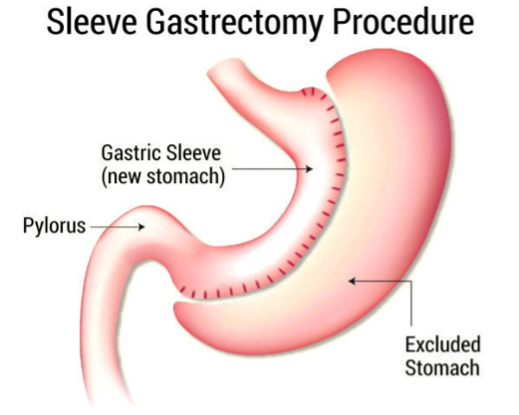
- About three quarters of the stomach is removed.
- Stomach capacity is reduced from a large pouch to approximately 200 mL.
- The remaining stomach is a long narrow tube or “sleeve”.
- The operation is permanent and is not reversible.
- It reduces the amount you can eat and also affects hunger hormones.
over approximately 12 to 18 months.
Make a small stomach pouch and reroute food
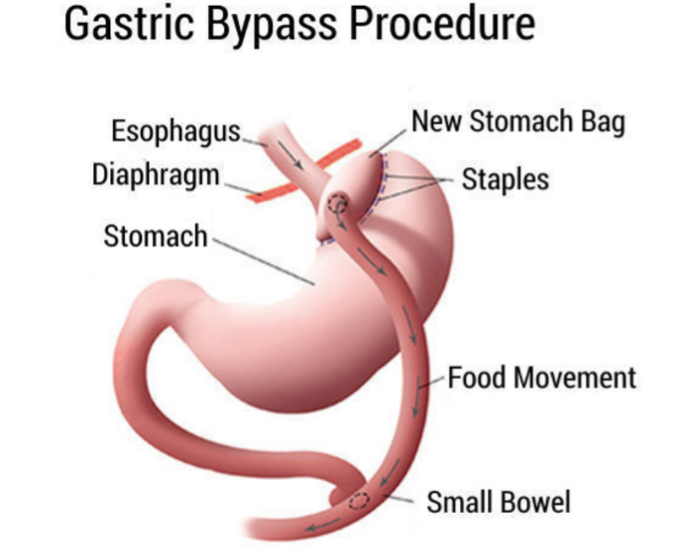
- The top of the stomach is made into a 30 to 50 mL pouch.
- The small pouch is connected to a segment of small intestine.
- This restricts how much you can eat.
- It also creates a degree of malabsorption because food bypasses part of the usual digestive pathway.
- It can also have important metabolic benefits, particularly for people with diabetes.
after gastric bypass.
These results are described as “excess weight loss”. That is not the same as saying you will lose 40 to 70% of your total body weight. Ask the bariatric team to translate the figure into what it may mean for you.
More about sleeve gastrectomy How it works, advantages and what happens afterwards
What happens during the operation?
The operation can usually be performed using laparoscopic or keyhole surgery, although sometimes a larger incision is needed for safe completion.
A tube is placed into the stomach to help guide the surgeon. A stapling and cutting device is then used along the stomach to remove a large portion of it.
What remains is a narrow stomach sleeve. It is permanently smaller.
It is not just restriction
The stomach also produces a hormone called ghrelin, which is involved in hunger. Removing part of the stomach reduces ghrelin levels and can improve hunger control.
Earlier fullness and improved glucose control are also part of why people can lose weight relatively rapidly during the first 6 to 12 months.
What are the advantages?
- It provides a fixed restriction without needing adjustments.
- Appetite may reduce.
- Normal types of food can usually still be eaten, but in much smaller amounts.
- Obesity-related health problems, including diabetes, may improve substantially in some patients.
What is the catch?
After the first year, the dramatic weight-loss phase usually settles. Weight may plateau and there can be a tendency to regain some of it.
The operation helps enormously, but you still have to work with it. Long-term food choices, follow-up and support are part of the treatment.
More about gastric bypass Restriction, bypassing intestine and long-term nutrition
There are two parts
The top of the stomach is divided to create a small pouch of approximately 30 to 50 mL.
The pouch is joined to a segment of small intestine, directing food away from the upper part of the usual digestive pathway.
This means the bypass combines strong restriction with some malabsorption.
What are the advantages?
- It provides fixed restriction without needing adjustment.
- Typical excess weight loss is around 60 to 70%.
- It can have major metabolic benefits for patients with diabetes.
And the trade-off?
Because food bypasses part of the normal digestive pathway, nutrition needs more attention afterwards.
Vitamin and mineral deficiencies, dumping syndrome, dental problems and lifelong nutritional monitoring all need to be considered.
Some important differences
| Feature | Sleeve | Bypass |
|---|---|---|
| Stomach made smaller | Yes | Yes |
| Intestine bypassed | No | Yes |
| Typical excess weight loss | 40 to 60% | 60 to 70% |
| Weight regain possible | Yes | Yes |
| Dumping syndrome | Not usually a major feature | About 70% |
| Lifelong vitamin monitoring | Important | Particularly important |
What are the risks of bariatric surgery? The detailed comparison
Sleeve and bypass share many complications, but there are also some important differences.
These numbers are useful for understanding the scale of the risks, but they cannot tell you exactly what will happen to you.
Operation and digestive-system complications
| Issue | Sleeve | Bypass |
|---|---|---|
| Dehydration | Yes | Yes |
| Bowel-function changes | Yes | Yes |
| Gastro-oesophageal reflux | About 20% after 1 year, about 3% after 3 years | Yes |
| Dumping syndrome | Not usually a major feature | About 70% |
| Food trapping | Not usually a major feature | Up to 2% |
| Weight regain | Yes | Yes |
| Gallstones | Up to 1 in 3 | Up to 1 in 3 |
| Inflammation of the stomach | Yes | Yes |
| Bowel blockage / internal hernia | Yes | About 3% |
| Leak from bowel or stomach staples | About 2% | About 2% |
| Enlargement of the oesophagus | Yes | Yes |
| Hiatus hernia | Yes | Yes |
| Abscess beside stomach or bowel | Yes | Yes |
| Stomach ulcers | Yes | Yes |
| Nausea, vomiting or stomach cramps | Yes | Up to 70% |
| Narrowing of the bowel | About 1% | About 5% |
| Organ injury during surgery | Yes | Yes |
Nutrition and longer-term effects
| Issue | Sleeve | Bypass |
|---|---|---|
| Skin changes / loose skin | Yes | Yes |
| Hair loss | Yes | Yes |
| Dental problems | Less prominent | Yes |
| Iron, B12 or folate anaemia | Occasionally | Yes |
| Kidney stones | Less prominent | Yes |
| Low blood sugars | Less prominent | Yes |
| Vitamin / mineral deficiency, malnutrition or malabsorption | Yes | Yes |
| Food intolerance | Yes | Yes |
General surgical complications
| Issue | Sleeve | Bypass |
|---|---|---|
| Deep vein thrombosis / pulmonary embolus | Yes | Yes |
| Bleeding | About 1% | About 2% |
| General anaesthetic complications | Yes | Yes |
| Hernia through the wound | Yes | Yes |
| Heart attack | Yes | Yes |
| Wound infection | Yes | About 3% |
| Stroke | Yes | Yes |
| Wound reopening | Yes | Yes |
| Pneumonia | Yes | Yes |
Who helps me keep the weight off?
Long-term success is not just the surgeon's job. The people around you matter too.
Regular review in the days, weeks, months and years after surgery helps keep you on track and looks after your overall health.
Your GP can monitor weight, nutrition and the health problems you had before surgery.
Dietitian review before and after bariatric surgery is an important part of treatment.
Habits, mindset and your relationship with food still matter after the anatomy has changed.
An exercise specialist can help improve fitness and support long-term maintenance.
Weight-loss medication may still have a role if hunger or weight regain becomes a problem.
It does not mean the whole treatment has failed
Weight regain can occur after both sleeve and bypass. A sleeve can enlarge over time and, for some people, conversion from a sleeve to a gastric bypass may later be considered.
Medication, nutrition, psychology and other support can also be used to help with weight maintenance.
Weight-loss surgery and reconstruction are different decisions
If bariatric surgery is part of your plan, the aim is to improve your weight and health before I undertake the much bigger job of rebuilding your abdominal wall.
Losing enough weight does not automatically mean that reconstruction is now safe or technically possible.
I will reassess the hernia, the CT, your fitness, diabetes, smoking, nutrition, breathing and the other things that affect the operation before we decide what happens next.
I have had bariatric surgery and the weight is coming off quickly. Is the hard part basically finished?
This is a self-check only. Your answer is not saved or sent anywhere.
Bariatric surgery is a treatment for obesity.
Sleeve and bypass work differently.
Both operations have important short and long-term risks.
Long-term success needs ongoing follow-up and support.
Abdominal wall reconstruction remains a separate decision afterwards.
Does bariatric surgery make sense in my plan?
If we are considering another operation before your reconstruction, you should understand why and what we are hoping to achieve.
Saved on this device. Nothing is sent automatically. Your questions appear in the same My Questions list as the main reconstruction guide.
Now come back to the bigger plan
Weight is one part of getting you ready. Your abdominal wall reconstruction also depends on smoking, diabetes, nutrition, fitness, breathing, medicines, tests and the anatomy of your hernia.
You can come back to this companion at any time. Your saved questions stay with the main Abs of Steel guide.
Return to the main guide Chapter 4: Getting myself ready