Preparing for your consultation
You do not need to learn everything about varicose veins before your appointment.
What is useful to think about beforehand?
If troublesome veins or symptoms in your legs are affecting you, your GP may suggest seeing a vascular surgeon for a more detailed assessment.
It is more useful to think about:
what is bothering you
how it affects your everyday life
what you would most like to improve
anything you are worried about
questions you would like answered

The consultation adds a specialist assessment
Your GP knows you and your wider health and has helped start this process.
The specialist consultation adds a vascular assessment and, if appropriate, further investigation and discussion about treatment.
You, your GP and your specialist each have a part to play in deciding what happens next.
What happens at the consultation?
Sam or Ana will usually:
ask about your symptoms
examine your legs
ask about previous vein treatment and your general health
explain what they think may be happening
discuss whether further investigation might help
If treatment may be appropriate, Sam or Ana will usually arrange a specific ultrasound scan to map your veins before planning a procedure.

What are varicose veins? A short explanation if you want it
Varicose veins develop when valves inside superficial veins do not work properly and allow some blood to flow backwards.
This is called venous reflux.
We explain this in more detail later in the guide if treatment is being considered.
Was this section useful?
Thanks. Your feedback helps us improve these guides.
What could have been better?
Thanks. Your feedback helps us improve this guide.
 Patient guide
Varicose veins and radiofrequency ablation
Written by Sam Taylor and Anastasia Dean, vascular surgeons at Compass Surgical, to help you prepare for your consultation, understand your options and know what to expect if radiofrequency ablation becomes part of your treatment plan.
Your vein treatment journey
The first section helps you prepare for your specialist consultation. The remaining sections explain investigations, treatment, risks and recovery if these become part of your plan.
Guide contents
About 3 minutes
Think about your symptoms, priorities and questions before meeting Sam or Ana.
Understand your treatment
Come back to these sections after Sam or Ana has assessed you.
What matters to you
People come to see us for different reasons.
What would you most like help with?
Think about what is bothering you and what you would most like to improve.
Select any that apply
Some people want to ask
Tap any question to add it to My questions.
Add your own question
Bring your questions and priorities with you
You do not need to work through detailed information about procedures and risks before Sam or Ana have assessed you.
Was this section useful?
Thanks. Your feedback helps us improve these guides.
What could have been better?
Thanks. Your feedback helps us improve this guide.
Your veins and ultrasound
Understanding where blood is flowing backwards helps Sam or Ana decide whether treatment may help.
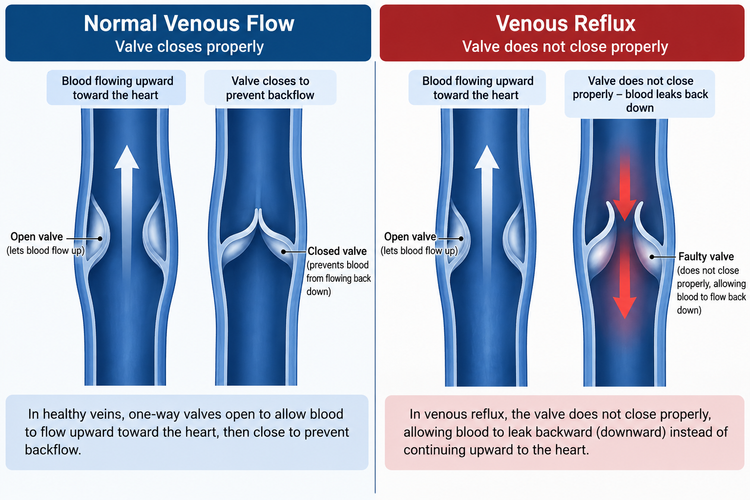
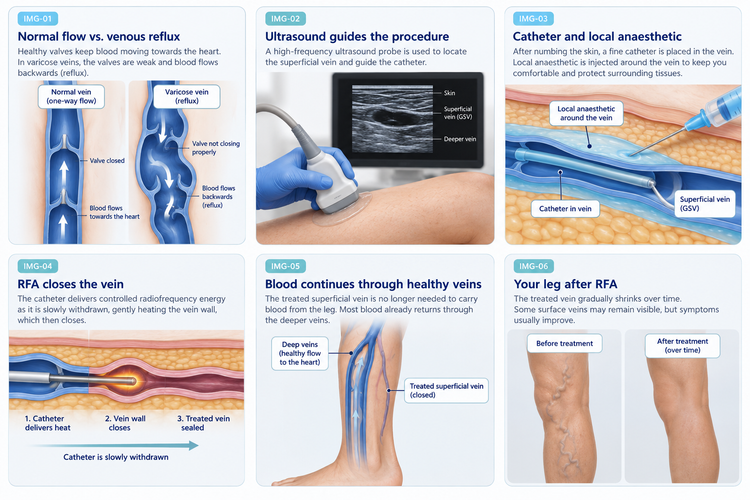
Veins normally carry blood back towards your heart
Small valves inside the veins help keep blood travelling in the right direction.
In a healthy vein, the valves open to allow blood to move upwards and then close to help prevent blood flowing backwards.
If a valve does not close properly, some blood can leak backwards down a superficial vein.
Aching or heaviness
Swelling
Throbbing or itching
Inflammation
Skin changes
Visible varicose veins
How the veins look does not always tell us how much they are affecting you.
Why do I need an ultrasound?
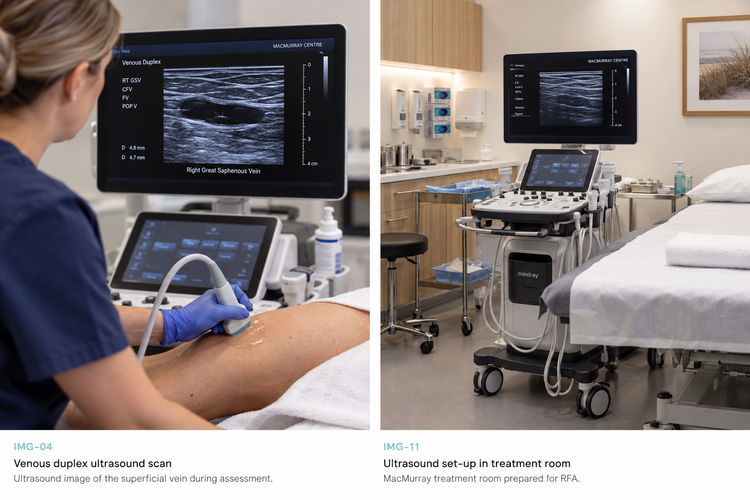
After your consultation, Sam or Ana will usually request a venous duplex ultrasound.
It shows:
which veins are working normally
where reflux is occurring
which superficial vein may be responsible
the anatomy needed to plan treatment safely
A vascular sonographer performs the scan using an ultrasound probe. You may be asked to stand for part of it.
There are no needles, injections or radiation.
Why do I need a scan if Sam or Ana have already examined me? Examination and ultrasound answer different questions
Your consultation tells us about your symptoms and clinical problem.
The ultrasound answers a different question:
Which vein is responsible, and how should it be treated?
Two people with similar-looking veins can have very different patterns of reflux underneath the skin.
Was this section useful?
Thanks. Your feedback helps us improve these guides.
What could have been better?
Thanks. Your feedback helps us improve this guide.
Your treatment options
There may be more than one reasonable option.
Once your symptoms, examination and ultrasound findings are considered together, Sam or Ana can recommend what is appropriate for you.
What might RFA improve?
Depending on what is causing your symptoms, treatment may improve:
Aching
Heaviness
Swelling related to venous reflux
Throbbing or irritation
Inflammation
Some skin symptoms
Sam or Ana will explain which of your symptoms they think are likely to improve.
RFA does not necessarily make every visible vein disappear
RFA treats the underlying refluxing vein.
It does not directly remove every surface varicose vein.
Some visible veins may become less prominent afterwards. Others may remain.
If appearance is particularly important to you, discuss this before treatment.Can varicose veins come back?
Yes.
RFA treats the vein that is abnormal now. It cannot remove your underlying tendency to develop problems with other vein valves.
New varicose veins can therefore develop in the future.
Earlier, you told us what matters to you
You have not saved any priorities yet.
Was this section useful?
Thanks. Your feedback helps us improve these guides.
What could have been better?
Thanks. Your feedback helps us improve this guide.
How radiofrequency ablation works
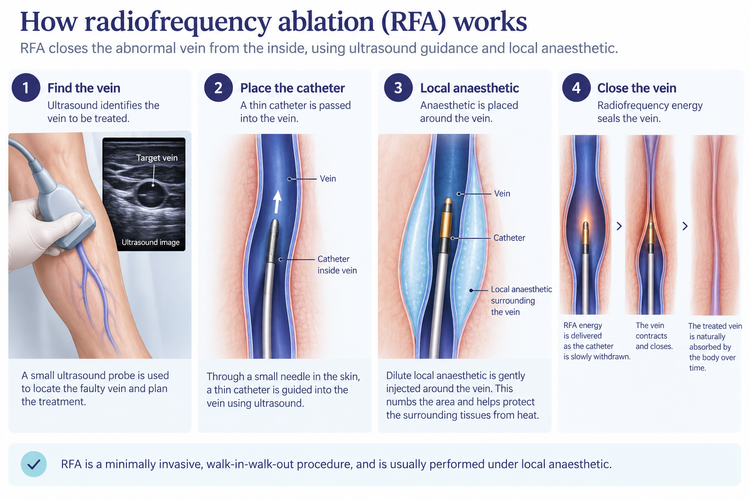
RFA closes the abnormal superficial vein from the inside.
The faulty vein is closed rather than removed
Radiofrequency ablation, or RFA, uses a thin catheter placed inside the abnormal vein.
Controlled radiofrequency energy heats the vein wall, causing the vein to close.
What actually happens?
Ultrasound is used to locate the abnormal vein and guide treatment.
The catheter is inserted through a small needle entry in the skin and positioned inside the abnormal superficial vein.
This helps keep you comfortable and separates the treated vein from surrounding tissues.
Controlled heat is delivered through the catheter. As the catheter is withdrawn, the vein wall contracts and closes.
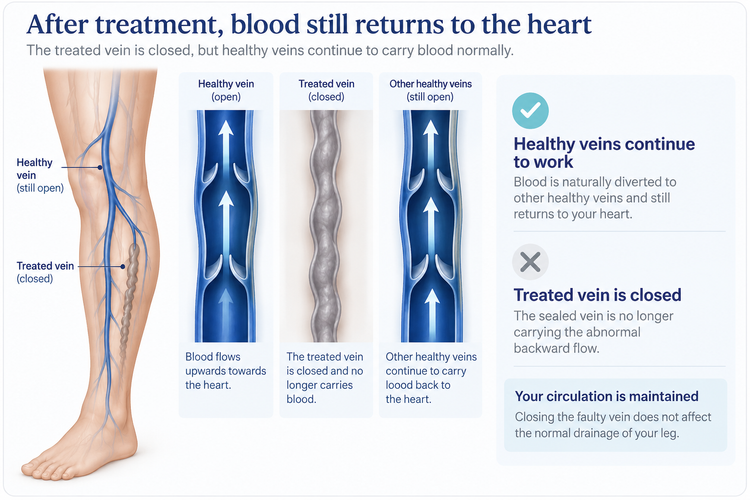
Where does the blood go?
Closing a faulty superficial vein does not stop blood returning from your leg.
Blood is naturally redirected through other healthy veins and continues back towards your heart.
After the abnormal superficial vein is closed, where does the blood go?
Choose the answer that makes the most sense to you.
What will I feel during RFA? What to expect during the procedure
You are awake for the procedure.
You may feel the local anaesthetic being injected and some pressure or pulling while the vein is treated.
The aim is to keep you comfortable throughout. Tell the team if you are uncomfortable at any point.
Was this section useful?
Thanks. Your feedback helps us improve these guides.
What could have been better?
Thanks. Your feedback helps us improve this guide.
Risks and trade-offs
It is useful to understand what is normally expected afterwards, what can sometimes go wrong and which risks matter most to you.
Some symptoms are expected while the treated vein heals
These are common effects of treatment and do not necessarily mean that something has gone wrong.
Chapter 8 explains what you can do during recovery and when symptoms should prompt you to contact the team.
Possible complications
Phlebitis
The treated vein or nearby veins can become inflamed and feel tender, hard, warm or red.
Numbness or tingling
Small nerves can lie close to superficial veins. Temporary altered sensation can occasionally occur.
Skin staining
Brown pigmentation can occasionally develop over a treated vein.
Incomplete closure
Occasionally the vein does not completely close or later reopens.
Complications you should know about
Deep vein thrombosis
A DVT is a blood clot in one of the deeper veins of the leg.
Published estimates vary between studies and individual risk can be different.
Extension of clot towards a deep vein
Very occasionally, clot associated with the treated vein can extend towards a deeper vein.
Pulmonary embolism
Very rarely, a blood clot can travel to the lungs.
Skin burn
RFA uses heat, so injury to surrounding tissue is possible but uncommon.
Infection
Infection at the small catheter entry site is uncommon.
Is there a particular risk you want to discuss?
Select anything you would like to ask Sam or Ana about.
You do not have to make every decision in the room
You may think of questions after leaving the consultation. You can keep them here and return to them before treatment.
Your questions stay on this device unless you choose to share them.Was this section useful?
Thanks. Your feedback helps us improve these guides.
What could have been better?
Thanks. Your feedback helps us improve this guide.
Your treatment day at MacMurray
Knowing what to expect can make the day feel much more straightforward.
A few practical things to organise
Take your usual medicines unless Sam or Ana has specifically asked you to change them.
If you take blood-thinning medicine, follow the instructions you have been given.
RFA is usually performed using local anaesthetic, so most people can eat and drink normally beforehand unless they have been given different instructions.
Wear comfortable, loose-fitting clothing that is easy to put back on after treatment.
Plan your transport home in advance and follow the specific driving advice given by your treatment team.

What happens when you arrive?
The team will confirm your details and prepare you for the procedure.
Sam or Ana will confirm which leg and vein are being treated and make sure you have had the opportunity to ask questions.
You do not currently have any outstanding saved questions.
Ultrasound is used again to confirm the vein and mark the treatment pathway.
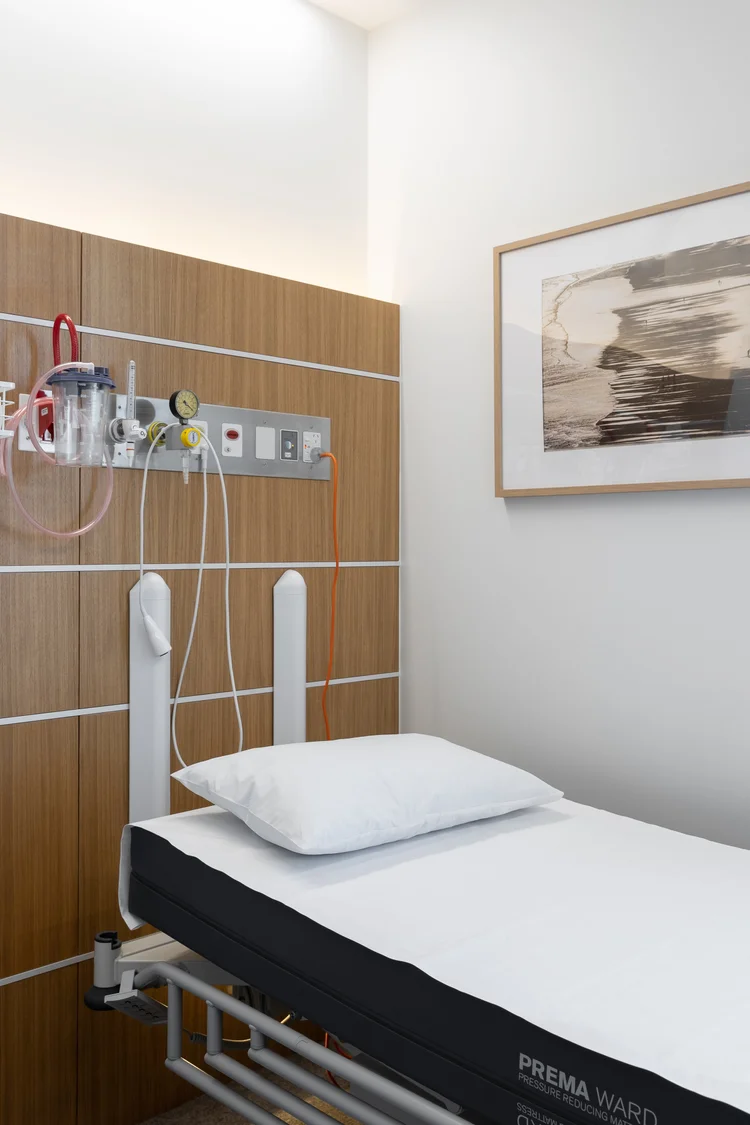
You will be positioned comfortably while the leg is prepared using sterile technique.
Local anaesthetic is placed around the vein. A thin catheter is then used to close the abnormal vein using radiofrequency energy.
You are usually awake throughout.
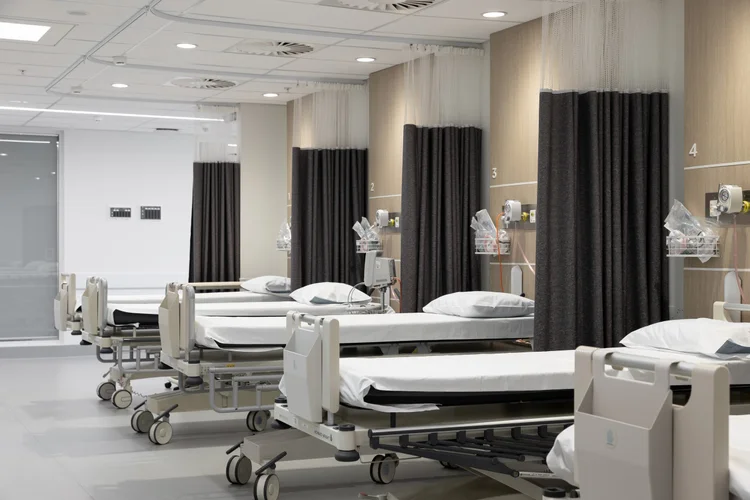
A dressing and compression may be applied after treatment.
You will normally be encouraged to get up and walk rather than remaining still.
Most people are able to go home the same day after a short period of recovery.
The team will explain what to do over the next few days and when to seek help.
After RFA, should you stay completely still for the rest of the day?
Choose the answer that makes the most sense to you.
What should I bring with me? A simple treatment-day checklist
Your usual medication list
Any questions you still want answered
Comfortable, loose-fitting clothing
Your transport plan for getting home
Was this section useful?
Thanks. Your feedback helps us improve these guides.
What could have been better?
Thanks. Your feedback helps us improve this guide.
Recovery and follow-up
Most people are walking straight away and return gradually to normal activity over the following days.
What should I do when I get home?
Walk normally and regularly from the day of treatment.
You do not need bed rest.Wear the compression stocking provided for 7 days.
Unless Sam or Ana gives you different instructions, wear it during the day and remove it for sleeping and showering.
Mild aching or tenderness is common.
Paracetamol can be used as directed if you need pain relief.
Do not drive yourself home after treatment.
You can usually return to driving after 24 to 48 hours once you can walk comfortably, move your leg freely and perform an emergency stop without pain or hesitation.
Keep the puncture-site dressing clean and dry for the first 24 hours.
After that you can usually shower normally. Avoid soaking the leg in a bath, spa or swimming pool for about 48 hours.
Work, exercise and travel
Many people with light or desk-based work return within 1 to 2 days.
If your work involves prolonged standing, heavy lifting or strenuous physical activity, you may need a little longer.
Walking is encouraged immediately.
Avoid strenuous exercise, heavy lifting and high-intensity lower-limb exercise for about 1 week.
After that, increase activity gradually according to comfort.
Avoid flying for about 2 weeks after RFA where possible.
If you need to fly sooner, or you are planning a long-haul flight, discuss this with Sam or Ana.
What is normal?
Some symptoms are common as the treated vein heals.
- bruising
- mild aching or tenderness
- tightness along the treated vein
- a firm or slightly lumpy area under the skin
- mild discomfort around the catheter entry site
Contact MacMurray if
- pain is getting significantly worse rather than improving
- redness is spreading
- there is discharge from the puncture site
- swelling is much greater than expected
- you develop significant new calf pain
- you have persistent numbness or altered sensation that concerns you
- anything about your recovery does not feel right
Seek urgent medical help if
- sudden or marked swelling of the leg
- severe unexplained calf or leg pain
- sudden shortness of breath
- chest pain
- coughing up blood
- collapse, fainting or severe illness
Which symptom needs urgent medical assessment?
There is no score or pass/fail result. Your answer is not recorded clinically.
What happens to the vein?
The treated vein gradually shrinks and becomes less prominent over time.
Some surface varicose veins may remain visible even though the underlying refluxing vein has been treated.
If symptoms or troublesome veins remain once the leg has settled, Sam or Ana can reassess you.
Will I need another ultrasound? Follow-up depends on your treatment and recovery
A follow-up ultrasound is not necessarily required for every patient after an uncomplicated RFA procedure.
Sam or Ana will arrange another scan if it is appropriate because of your treatment, symptoms or recovery.
Your care remains connected
Your GP helped start this process and remains part of your ongoing care.
If new symptoms develop later, you can contact Sam or Ana or discuss them with your GP.
Was this section useful?
Thanks. Your feedback helps us improve these guides.
What could have been better?
Thanks. Your feedback helps us improve this guide.
Questions still on your mind?
Review anything you saved while using the guide.
No outstanding questions saved.
No priorities saved.
Your questions and priorities are stored on this device.
You have the right to information and informed choice
In New Zealand, people using health and disability services are protected by the Code of Health and Disability Services Consumers' Rights.
This includes your rights to:
receive information you can understand
know the reasonable options, benefits and risks
ask questions and receive answers
make an informed choice and give informed consent
have a support person with you
raise concerns or make a complaint
Supporting your discussion with your clinical team
This guide provides general information about varicose veins, radiofrequency ablation and recovery.
It is designed to help you prepare, understand the information relevant to your care, save questions and return to the information after your consultation.
It supports, but does not replace, individual discussion with your GP, Sam or Ana.
Recommendations may differ according to your symptoms, ultrasound findings, medical history and individual circumstances.
Clinical governance
- Guide
- Varicose veins and radiofrequency ablation
- Clinical content
- Sam Taylor and Anastasia Dean, Vascular Surgeons
- Service
- Compass Surgical at MacMurray Centre
- Patient education platform
- Loupa Patient Education
- Version
- 1.0
- Status
- Patient guide
- Review cycle
- Annual review or earlier if clinical practice changes
Contact Compass Surgical or MacMurray Centre.
Keep it available if questions come up later
You can return to the guide after your consultation or treatment, share it with someone supporting you, and review your saved questions at any time on this device.