
Your hernia guide
Understand your hernia, compare your treatment options and prepare the questions that matter to you before meeting your surgeon.
You do not need to decide anything before your appointment. Your surgeon will assess your individual hernia, discuss the options with you and help you decide what is right for you.
Your hernia journey
Start with the short consultation section below. If surgery later becomes part of your plan, return to the same guide for preparation, the day of surgery and recovery.
Preparing for your consultation
The essential information to read before seeing your surgeon.
Preparing for treatment and recovery
You do not need to read these sections before your first consultation.
Not every hernia needs an operation. Your consultation is where you and your surgeon compare the benefits of waiting or repair against the risks and recovery that matter to you.
Use the guide in the way that helps you
You do not need to learn everything before your appointment. Focus on understanding the main choices, what matters to you and any questions you want to discuss.
Learn why some hernias can be watched, when repair may become worthwhile and what the important benefits and risks are.
Keep anything you want to ask in My questions. During your consultation, mark each question as discussed as you work through them together.
Share the guide with whānau, a support person or your GP if that helps you think through the decision or remember what you want to discuss.
If a question needs answering before your next consultation, you can email your outstanding questions to the surgical team. Otherwise, keep them saved and discuss them at your appointment.
The guide provides general information and helps you prepare. Your consultation is where your symptoms, examination, hernia type, health, priorities and questions are considered together before deciding what happens next.
Who are you seeing?
Select your surgeon if you know. You can also leave this blank.
Understand your hernia
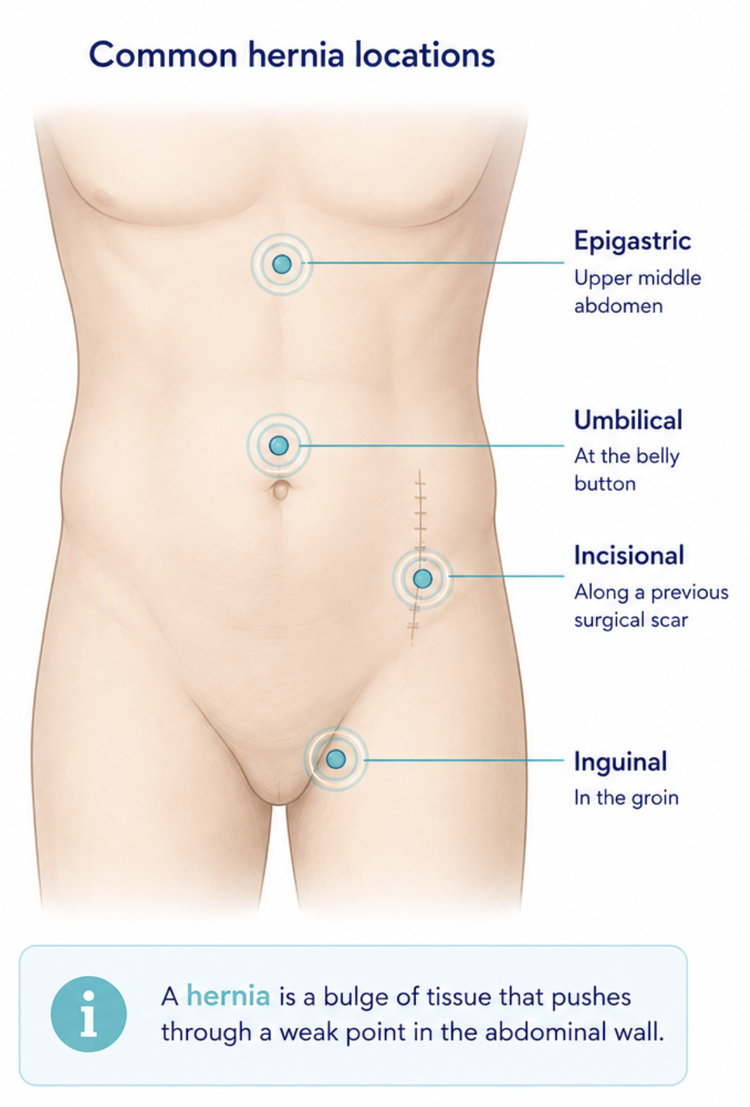
A hernia happens when tissue pushes through a weak point or opening in the abdominal wall.
What is a hernia?
Your abdominal wall is made of layers of muscle and supporting tissue. If there is a weak point or opening, fat, bowel or other tissue can push through it and form a lump.
The lump may be more noticeable when you stand, cough, lift or strain because pressure inside the abdomen increases.
What might I notice?
Some hernias cause very little discomfort. The size of the lump does not always match how troublesome the symptoms are.
When should a hernia be assessed urgently?
Seek urgent medical assessment if a hernia becomes suddenly or increasingly painful, firm or swollen, especially if it no longer goes back in when it normally would.
Vomiting, increasing abdominal pain, abdominal swelling or feeling significantly unwell are also reasons to seek urgent assessment.
If symptoms are severe or rapidly worsening, do not wait for a routine surgical appointment.Learn more if you want to
You do not need to remember this information for your consultation.
What types of hernia are there? Inguinal, umbilical, epigastric and incisional hernias
A hernia in the groin. This is one of the most common types of abdominal wall hernia.
A hernia at or close to the belly button.
A hernia in the midline of the upper abdomen, usually between the belly button and breastbone.
A hernia that develops through or close to the scar from a previous abdominal operation.
Why can the lump come and go? What surgeons mean by a reducible hernia
A hernia may become more obvious when pressure inside the abdomen increases, such as when standing, coughing, lifting or straining.
When you lie down or relax, the tissue may move back through the opening and the lump becomes smaller or disappears. This is often described as a reducible hernia.
If a hernia that normally reduces becomes persistently firm, painful or unable to go back in, it should be assessed.
How is a hernia diagnosed? Examination is usually the most important step
Your surgeon will ask about the lump, your symptoms and how they affect you, then examine the area.
You may be asked to stand, cough or strain gently because this can make a hernia easier to feel.
A scan is not always needed. Imaging may be helpful if the diagnosis is uncertain or if more information is required before deciding what to do.
What will your surgeon work out?
The important questions are not simply whether a hernia is present, but what type it is, what symptoms it is causing, how it affects your life and whether treatment is likely to help.
Save a question
Tap a question to add it to My questions.
Compare your options
The main decision is usually whether to keep watching the hernia or consider repair.
Watch and review
This can be a reasonable choice if the hernia is causing few symptoms, is not interfering much with daily life and there is no specific reason it needs repair now.
- No operation at present
- Continue normal activity as advised
- Monitor symptoms and changes
- Review the decision if the hernia becomes more troublesome
Consider repair
Repair may become more worthwhile if the hernia is painful, repeatedly troublesome, limiting activity or affecting quality of life.
- Aims to relieve symptoms caused by the hernia
- Repairs and reinforces the weak area
- Requires an operation and recovery period
- Has important risks that need to be weighed against the benefit
Surgery becomes more worthwhile when the hernia is causing a real problem
Pain or discomfort clearly related to the hernia
Restriction of work, exercise or everyday activity
Progressive enlargement or increasing symptoms
Concern about the hernia that remains important after discussion
One important part of your consultation is deciding how likely the hernia is to be the true cause of your symptoms. Repair is less likely to help pain that is coming from somewhere else.
The same hernia can lead to different reasonable choices
Some people prefer to avoid surgery unless it is clearly necessary. Others place more importance on returning to unrestricted activity or reducing ongoing symptoms. Your health, work, lifestyle and attitude to risk all matter.
If repair is being considered
Open or keyhole repair? There is not one best approach for everyone
The hernia is repaired through an incision over or near the hernia. This can be a very good option for many patients.
The repair is performed using small incisions and a camera. This approach can be useful in selected situations.
The best approach depends on factors such as the type and size of hernia, whether it is one-sided or bilateral, previous surgery, your health and your surgeon's assessment.
Will mesh be used? Mesh is commonly used to reinforce the repair
Mesh is commonly used in adult hernia repair because reinforcing the weak area can reduce the chance of the hernia coming back compared with simply stitching the opening closed in many situations.
Whether mesh is recommended depends on the type of hernia and repair being considered. Your surgeon should explain why mesh is or is not recommended for you.
What does the operation actually do? The basic principle of repair
The tissue coming through the hernia is returned to the correct side of the abdominal wall. The weak area is then repaired and, where appropriate, reinforced with mesh.
Is the expected benefit of repair worthwhile enough to you to justify surgery, its risks and the recovery afterwards?
Save a question
Tap any question to add it to My questions.
Risks and what they mean
Hernia repair is commonly performed and serious complications are uncommon, but no operation is risk-free.
What does “10 in 100” mean?
It means that if 100 similar patients had the operation, approximately 10 might experience that outcome and around 90 would not.
These figures are estimates, not guarantees.
The best numerical evidence is often for inguinal or groin hernia repair. Where a number below mainly relates to groin hernia surgery, we say so. Umbilical, epigastric and incisional hernias may have different risks.
What complications should I know about?
Some effects are temporary and relatively common. Others are much less common but important because of their potential consequences.
Persistent pain or discomfort
Some people have ongoing groin pain or discomfort after inguinal hernia repair. The often-quoted figure of around 10–12 in 100 refers to clinically significant persistent pain in studies of groin hernia repair.
These figures relate specifically to groin hernia repair and should not simply be applied to every umbilical, epigastric or incisional hernia.
Bruising or a collection of blood
Bruising is common after hernia surgery. A larger collection of blood under the wound is called a haematoma.
Most settle with time. Occasionally a large or tense collection needs further treatment.
Reported rates vary considerably with the operation and how haematoma is defined.
Seroma
A seroma is a collection of clear fluid around the area that has been repaired. It can feel like a lump and can sometimes be mistaken for the hernia returning.
Most seromas gradually disappear without treatment.
Rates vary by technique and hernia type and can be higher after some larger or keyhole repairs.
Wound infection
A wound infection can cause increasing redness, pain, swelling or discharge and may require antibiotics or other treatment.
Infection involving the mesh itself is much less common than a superficial wound infection, but can be more difficult to treat and occasionally requires further surgery.
For uncomplicated groin hernia repair, superficial infection is generally in the low single-digit percentage range and is lower after many keyhole repairs.
Difficulty passing urine
Some patients temporarily have difficulty emptying their bladder after surgery or anaesthesia.
If this happens, a temporary urinary catheter may be needed until normal bladder function returns.
Published rates vary widely. Risk is influenced by factors such as age, prostate symptoms, anaesthetic technique, medicines and the type of operation.
The hernia coming back
No repair guarantees that a hernia can never recur. Modern mesh-based repairs have reduced recurrence compared with many older suture-only techniques.
The actual recurrence risk depends heavily on the hernia type, its size, whether it has been repaired before, the technique used and individual factors.
Your surgeon can give a more meaningful estimate once the type of repair being considered is known.
Mesh-related problems
Mesh is commonly used because it reduces recurrence in many types of hernia repair. Most patients do not develop a mesh-specific complication.
Possible problems include infection, persistent discomfort, contraction or movement of the mesh, or interaction with surrounding tissues.
There is no single useful percentage for “mesh problems” because these are different complications with different frequencies.
Injury to nearby structures
Structures close to a hernia can include nerves, blood vessels, bowel, bladder and, for groin hernias, structures supplying or travelling to the testicle.
Serious injury is uncommon, but if it occurs it can require additional treatment or surgery.
The structures at risk depend on the location of your hernia and the operation being performed.
Pain, swelling and bruising are expected early in recovery
Most patients have some soreness and may have bruising or swelling around the repair. These usually improve as healing progresses.
Chapter 07 explains what to expect at home and which changes should prompt medical advice.
What about the general risks of surgery and anaesthesia? Heart, lungs, blood clots and anaesthetic complications
Hernia repair also carries the general risks associated with surgery and anaesthesia. These can include:
- breathing or chest complications
- heart or circulation problems
- blood clots in the legs or lungs
- allergic or other reactions to medicines or anaesthesia
- very rarely, severe complications requiring intensive care
For most otherwise well patients having routine elective hernia repair, serious medical complications are uncommon. Giving one generic percentage would be misleading because the risk changes substantially with age, health, anaesthetic and complexity of surgery.
Your anaesthetist and surgeon will consider your individual medical risks before surgery.
What can change these numbers?
This is why your consultation matters. Population statistics provide context, but your surgeon needs to explain which risks are most relevant to the repair being considered for you.
Which statement is most accurate?
Where do these numbers come from? Evidence and limitations
The estimates in this guide are based on international hernia guidelines, systematic reviews and published studies.
Important sources include the international HerniaSurge groin hernia guidelines and their 2023 update, European Hernia Society guidance, and European and Americas Hernia Society guidance for primary umbilical and epigastric hernias.
Published complication rates vary because studies include different patients, operations, follow-up periods and definitions. Rounded figures are therefore used where they help explain the likely scale of risk rather than implying false precision.
The aim is not to find a risk-free option
Surgery has risks. Continuing to live with a symptomatic hernia also has consequences. The decision is about weighing the likely benefit of repair against the risks and recovery that matter to you.
Save a question
Tap a question to add it to My questions.
Prepare for your consultation
Your surgeon brings clinical expertise. You bring your symptoms, priorities, concerns and preferences.
What would make treatment worthwhile?
Choose anything that feels important. You can select more than one. Your choices will appear in My questions and in your consultation summary.
What do you want your surgeon to understand about you?
Work, exercise, caring responsibilities, travel, sport or everyday activities may influence whether treatment feels worthwhile.
This might be pain, anaesthesia, mesh, recovery time, complications or something else.
You may be concerned about symptoms worsening, the hernia getting larger or needing treatment later.
You should understand the options before deciding
Good consent is more than signing a form. You should have the opportunity to understand the information relevant to you and discuss anything that remains unclear.
Why surgery is or is not being recommended
The expected benefits and important risks
Reasonable alternatives, including continuing to watch the hernia where appropriate
An opportunity to ask questions and have them addressed
Enough information to make your own decision
Save anything you still want to discuss
Your questions stay on this device until you choose to show or email them.
Your surgeon will combine what is known about your hernia with your symptoms, health, priorities and questions before recommending what happens next.
Ready for your consultation?
Review what matters to you and the questions you still want to discuss. You can open this again on your phone during your appointment.
My priorities
You have not selected any priorities yet.
Questions to discuss
During your consultation, mark each question as Discussed as you work through them.
Email your surgical team if you need an answer before your next consultation
Otherwise, keep your questions saved and discuss them at your appointment. If you do choose to email, your outstanding questions and selected priorities will be placed into an email for you to review before sending.
Nothing is sent automatically.
Share the guide if that would help
You can share it with whānau, a partner, support person or your GP before or after the consultation.
Do you feel prepared for the conversation?
These are not requirements. They are simply prompts that may help you get more from your consultation.
You do not need to know everything. Bring your priorities and questions and work through them with your surgeon.
You can stop here for now
The sections below are for patients who go on to have surgery. You do not need to read them before your first consultation.
Preparing for treatment and recovery
The rest of the guide is for patients who have decided to proceed with surgery. Return to it when your operation has been planned.
Getting ready for surgery
Your booking information and hospital instructions are the most important source of information for your individual operation.
Preparation checklist
Follow your fasting instructions carefully
Your hospital or anaesthetic team will tell you when to stop eating and when you can continue drinking clear fluids.
If you accidentally eat or drink outside the instructions you were given, tell the clinical team. Do not hide it, as this can affect the safety of your anaesthetic.
Do not stop regular medicines unless you have been told to
Some medicines need special planning before surgery. Make sure the team knows what you take, including prescribed medicines, over-the-counter medicines and supplements.
If you are going home on the day of surgery, arrange safe transport and follow any instructions about having someone stay with you.
It can help to organise simple meals, pain relief, comfortable clothing and practical support before the operation.
It is still fine to ask
If anything about the operation, alternatives, important risks or recovery remains unclear, ask before surgery.
What happens before theatre?
You will check in, meet members of the clinical team and have the important details of your operation and anaesthetic confirmed before going to theatre.
Your identity, planned operation, consent and relevant clinical information are checked as part of the normal safety process.
The day of surgery
The team will confirm your operation, keep checking your safety and help you recover before you leave hospital.
Checking in
After you arrive, members of the clinical team will confirm important information such as your identity, medical history, medicines, allergies and the operation being planned.
Your surgeon and anaesthetic team will make sure the relevant information has been discussed and that you have an opportunity to ask any final questions.
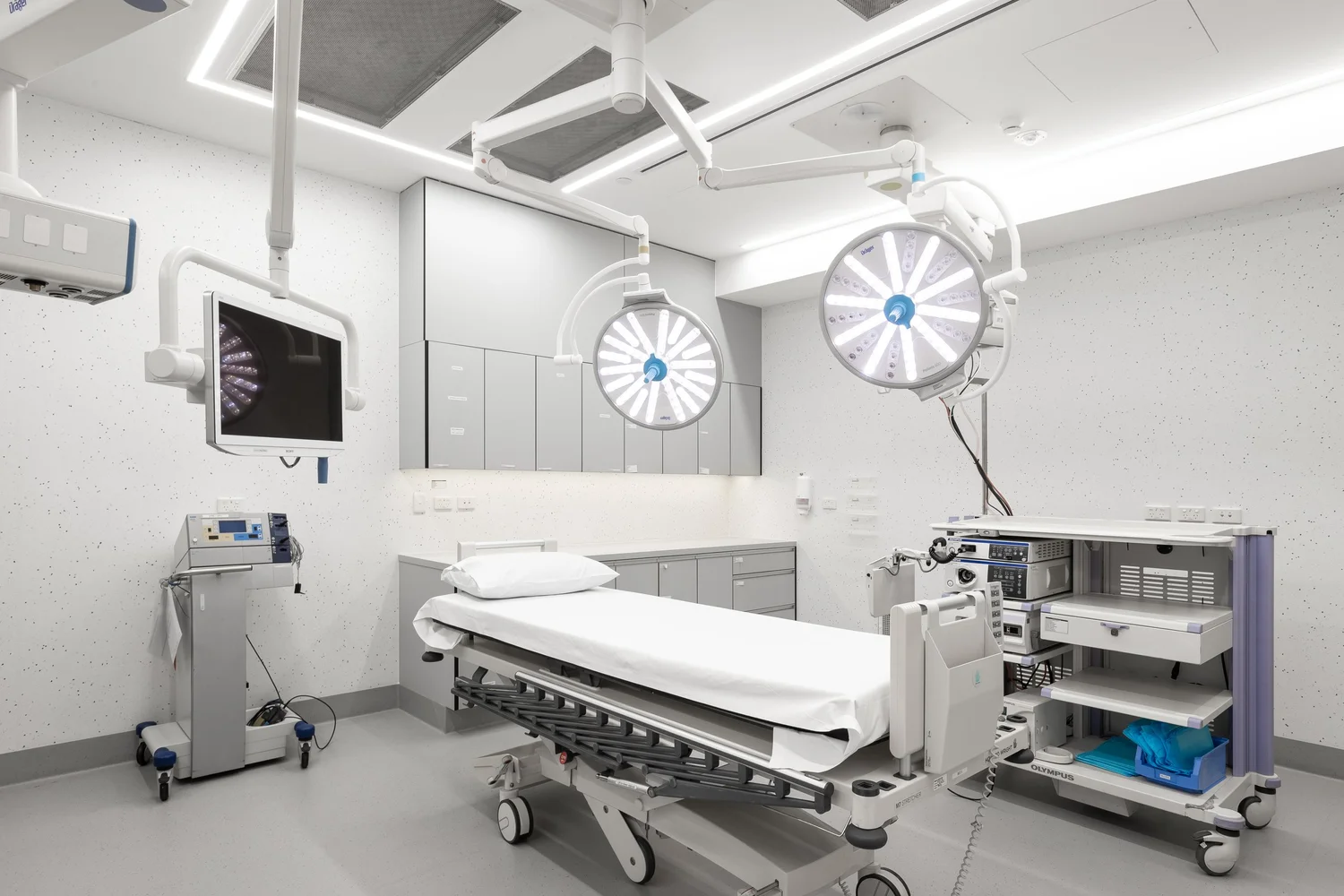
What happens before the operation starts?
The team performs formal safety checks to confirm who you are, the planned operation and other important clinical information.
You will then have your anaesthetic. Keyhole hernia repair requires a general anaesthetic. Open repair is also commonly performed under general anaesthesia, although other anaesthetic approaches may sometimes be appropriate.
What actually happens during the repair? A simple overview of the operation
The surgeon exposes or approaches the weak area in the abdominal wall.
Tissue that has pushed through the opening is returned to the correct side of the abdominal wall.
The opening is repaired and, where appropriate, reinforced with mesh.
The incisions are closed and dressings are applied as needed.
Mesh used for hernia repair is generally intended to remain in place permanently.
Waking up in recovery
You will wake in the recovery area where a nurse will monitor you while the anaesthetic wears off.
It is normal to feel sleepy and sore. Some people also feel nauseated. The team will monitor your observations, wounds and comfort and give pain relief or anti-nausea treatment if needed.
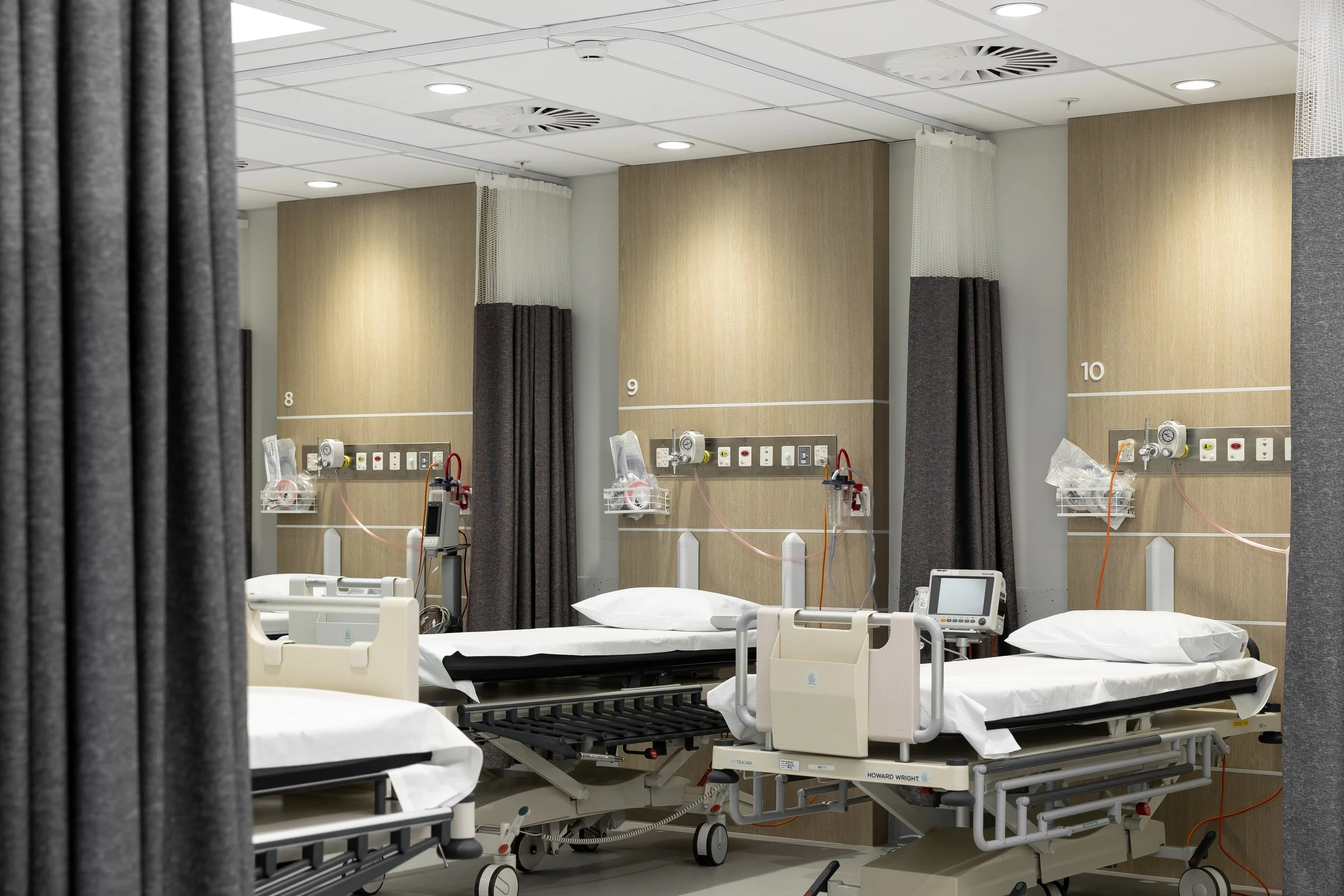
What is normal soon after surgery?
When are you ready to leave?
Before discharge, the team will make sure your immediate recovery is satisfactory and that it is safe for you to continue recovering outside hospital.
Your immediate recovery is satisfactory
Pain and nausea are manageable
You can move safely enough for discharge
Any other individual discharge requirements have been met

Make sure you know what happens next
Know what to take and how often.
Know how to care for your dressings and wounds.
Know what you can start doing and what to build up gradually.
Know which symptoms should prompt medical advice.
You can keep using My questions
If something is unclear before you leave, ask the team. You can also save recovery questions to discuss later.
Recovery and follow-up
Recovery is usually progressive. The aim is to stay comfortable, keep moving and gradually return to normal activity.
What is common early on?
It is normal to have lower energy, soreness around the repair and some bruising or swelling. These should gradually improve.
Keep discomfort manageable
Take the pain relief recommended on discharge. Good pain control makes it easier to walk, sleep, cough and move normally.
If pain is becoming more severe rather than gradually improving, seek advice.
Follow your dressing instructions
Keep the wounds and dressings as instructed by your surgical team. Some swelling, bruising and firmness around the repair can be normal.
Increasing redness, heat, swelling, discharge or worsening wound pain should prompt medical advice.
Gentle activity helps recovery
Get up and move regularly rather than spending long periods in bed. Short walks are a good place to start.
Gradually increase what you do according to comfort and the advice given for your particular repair.
Build activity up progressively
Start with comfortable everyday movement and gradually increase activity. Follow any specific lifting restrictions given by your surgeon.
Time away from work depends on the operation and what your job involves. Desk-based work may be possible sooner than heavy physical work.
Do not drive until you can safely control the vehicle, perform an emergency stop comfortably and are no longer affected by sedating medicines.
Return progressively. Pain or significant discomfort is a useful signal to reduce intensity and build up more gradually.
When should you contact someone?
Use the contact details provided at discharge
Your discharge information should tell you who to contact if you have a problem after surgery.
For non-urgent Compass Surgical enquiries you can also contact the team.
Call Compass SurgicalYour surgeon will tell you when review is needed
Follow-up is commonly around six weeks after surgery, but timing varies depending on the operation, your recovery and your surgeon's practice.
Do not wait for a routine follow-up appointment if you have a significant concern before then.
Save anything you want to ask
You can keep using My questions after surgery.
You can return here during your recovery
The same guide remains available if you want to revisit your recovery advice, warning signs or saved questions.